August 7, 2013

The Upside of the Cyberspace Echo Chamber


I love it when an article I write leads to the discovery of interesting new people, sites and blogs. Such was the case in the wake of my Atlantic.com article on eating invasive species.

An Oxford, England-based environmental geographer named Shonil Bhagwat, mentioned me in his blog, a thoughtful meditation on nature and culture in the anthropocene (a term adopted by ecologists to describe a new geological epoch dominated by the impact of humans). I've learned more from him about the importance of agrobiodiversity and wild crop conservation. Even weeds, he points out, are sacred because we'll need different, hardier species as our climate and geography continue to change.

In writing about out-of-control invasive species, Bhagwat notes that we can try to eradicate them, but another approach is "to reverse our gaze and accept that the invasives will continue to flourish alongside us. For a species of our size, we have changed the rules of the game by having a disproportionately large impact on the planet and in the process created space for other species like us."

I like that. Here we are bent out of shape that feral hogs or zebra mussels are so rapacious (for a list of the most destructive alien invasives, check this out). They might well be thinking in disgust, "that's the pot calling the kettle black."

Here's another example of the ability of social media to bring together worlds within worlds: When my Edible Manhattan profile of catering company Great Performances and its visionary CEO Liz Neumark appeared, it was picked up by a site I'd never heard of called The Triple Bottom, named after the term coined to describe a certain type of organizational success that equally values people, profit and planet. Browsing that fascinating site brought me to similar sites, like Triple Pundit, and this article on how increasing the number of women on corporate boards increases both profits and sustainability.

The only downside to all this connecting? When you fall down one of these virtual rabbit holes, it can be hard to get any work of one's own done.

July 22, 2013

Michael Anthony's Gramercy Tavern Cookbook

Chilled corn soup.
Outside the air was shimmering with heat and humidity but inside the private dining room at Gramercy Tavern it was all chill, from the refreshing corn soup to the lemon verbena granité. The occasion was a recent lunch introducing The Gramercy Tavern Cookbook, written by executive chef Michael Anthony.

The book, to be released in October, is a handsome collection of recipes, mini-profiles and stories published by Clarkson Potter. Union Square Hospitality group founder and co-owner Danny Meyer writes in his introductory history of the restaurant that he visualized his second restaurant as "the love child of Taillevent and Union Square Café," a combination of the casual spirit of the first and the elevated services and fine dining of the second.

Watermelon and beet salad.

Anthony told his lunch guests that he strives for the simplicity of home cooking at work, noting, "If we have the courage to cook at the restaurant the way we cook at home then we're a success. It's the opposite of what you would think." 

Anthony cooks at home for his wife and three daughters, and says he's excited about joining the Norwich Meadows Farm CSA and cooking from its offerings.

Flounder with marinated cucumbers and yogurt sauce.
I wondered if any of Anthony's experiences cooking in Japan made it into his book. He does write memorably about his impoverished days as a young cook living on the far outskirts of Tokyo and befriending a middle-aged Japanese woman. She dragged him to meetings of her "culture club," where he traded English lessons for instruction in both Japanese and Japanese home cooking, and "excursions with their straw-hat hiking club."

"Japanese people eat an amazing variety of carefully prepared foods every day, but that kind of home cooking hardly ever finds its way to Japanese restaurants in the United States," writes Anthony. He lists a few of key ingredients from those Japanese ladies' home kitchens that he loves most, and that have made their way into his pantry, including the very practical bottled shiro dashi, a mix of dashi (the basic building block of Japanese cuisine, a broth made of bonito flakes and dried seaweed), soy sauce, saké and other seasonings.  He likes to use shiro dashi to season fish and sauces.

Lemon verbena granite with blueberry sorbet.

The Gramercy Tavern Cookbook includes Anthony own dashi recipe, used in the book for a dish of halibut and radishes in beet dashi.

Now, says Anthony, he's fascinated with Korean cuisine. I'm looking forward to seeing how those influences might eventually appear on the Gramercy Tavern menu.

June 11, 2013

The Amazing Tokyo Basement Food Hall


One of my favorite memories of living in Tokyo is of wandering the eye-popping aisles the depachika, department store basements that are traditionally devoted to prepared food, produce and groceries. In Japan's culture of incessant gift giving, the depachika is handy for dropping into and buying the box of luxury rice crackers, container of Kyoto pickles or Japanese and western confections to take on your next social visit.

So I jumped when chef, sommelier, shōchū advisor, and now Tokyo food guide Yukari Sakamoto offered to take me on a quick tour of the Shinjuku Takashimaya's depachika during my recent trip to Japan. Yukari is also an author: she wrote a great book on Tokyo food culture, Food Sake Tokyo, which I wrote about in this post.

The first thing we saw were some amazing Muscat of Alexandria grapes (pictured above), sugared on the outside to look like gorgeous pieces of frost-covered Venetian glass, and much too beautiful to eat. The grape is from an ancient, genetically unmodified vine and its pure flavor is highly prized in Japan, where it is grown in greenhouses. Just take a look at this review of a Muscat of Alexandria-flavored KitKat bar, and you'll see how the glamorous globes have infiltrated every level of consumption in Japan. 


There were other beautiful fruit preparations, too, like these white peach halves suspended in kanten, or  arrowroot gelatin.


The famous Kyoko kaiseki restaurant Kikunoi has a pretty space in the Takashimaya depachika, and we swooned over not only the take-away foods on offer, but the gorgeous bowls they were served in, like this Oribe bowl, lower left, which held  unohana, a dish of okara (tofu lees) simmered with dashi, usukuchi (lighter in color but saltier in taste) soy sauce and mirin. This is a classic dish from Kyoko, which is famous for its tofu, explains Yukari. My grandmother made this dish with strips of carrot and I think bamboo shoots, and I always liked its taste and texture, which was slightly nubbly. Next to the unohana in the picture are bowls of kiriboshi daikon and hijiki.


When it comes to buying beef, most Americans can only dream about the kind of transparency that's  found in Japan. Check out the picture above. When you buy this kind of extravagatly-marbled beef at Takashimaya, the individual identification numbers of each type of meat is posted. You can then go to this site, input the ID number, and up pops information on your meat, from breed, gender, and date of birth to the hometown of the animal and location of its raising facility. Yukari says she's seen information on what the cow was fed, too, though that information doesn't seem to be included on this site. 


In the fish department each individually wrapped serving of sashimi is carefully labeled so that buyers will know the name of the four different types of fish included. When there are several different kinds of white fish, the labels can be helpful. While we've heard plenty of reports of mislabled fish in America, Yukari says this is not a problem in Japan. Her husband Shinji, a fishmonger and former Tsujiki fish market buyer "was always pointing out mislabeled seafood to me at American seafood counters," she recalls.

It the US, Yukari adds, "Sadly many people handling seafood have no idea what they are working with." The large variety of seasonal seafood in Japan has bred more knowledgeable fishmongers, and home cooks will even change up their cooking methods for a fish depending on when during the seaons it's purchased. "For example," she says, "katsuo (skipjack tuna) has a lean season and a fatty season," and preparation would vary accordingly. 

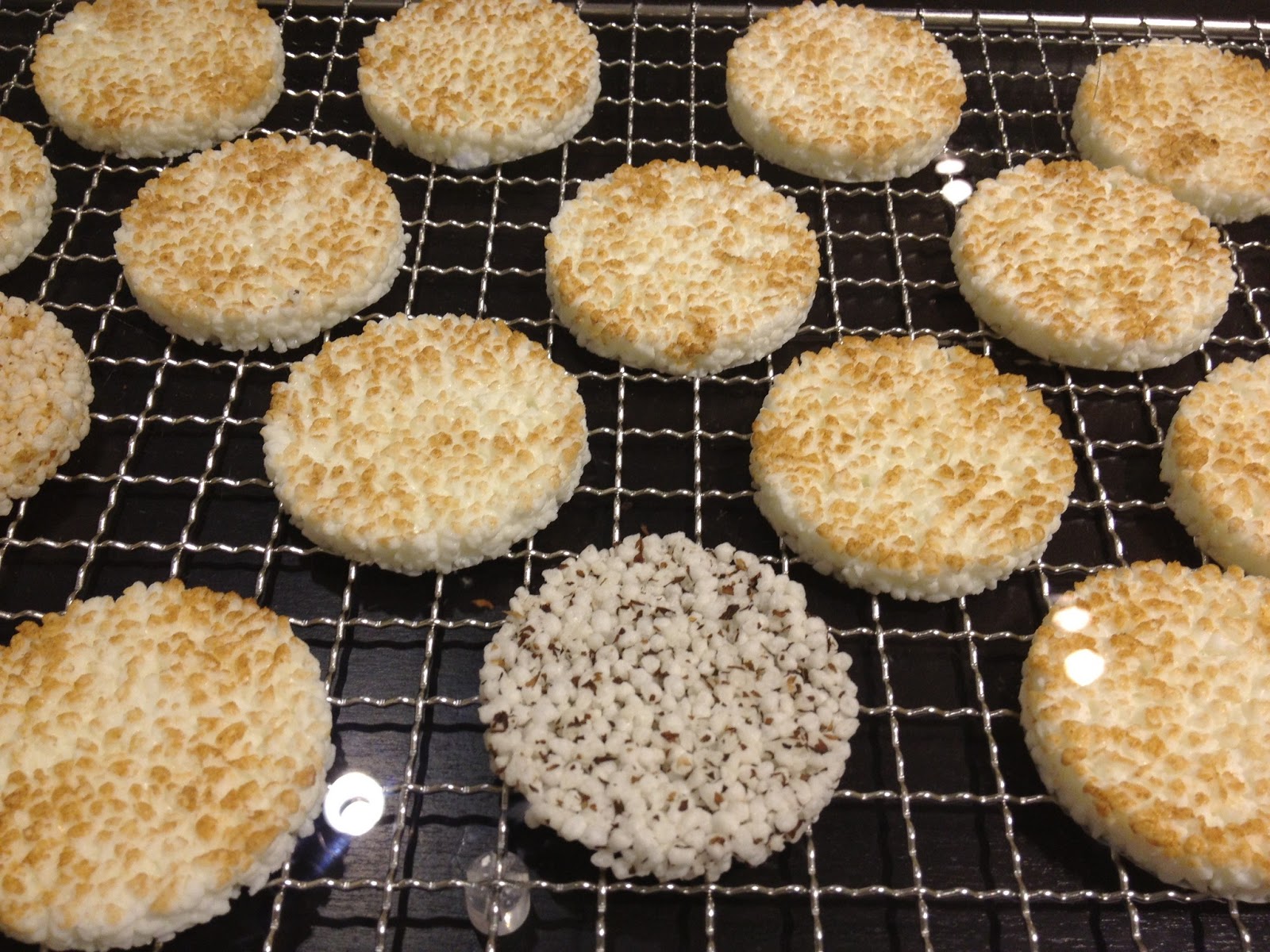
Here's a refined version of the puffed rice crackers that you can find in American health stores. 


International cuisines are not totally shunned, either. The shellfish in this paella kit looks better than anything you can  find in New York.

I learned a lot more on my tour, but this is probably more than enough for you. Thanks again for the great tour, Yukari!


May 28, 2013

In Tokyo, Mixologizing with the Seasons

Gen Yamamoto, ready for business.
One of the best parts of a highlight-filled trip to Tokyo recently was dropping in on Bar Gen Yamamoto. Gen joined David Bouley's New York City team in late 2010 and the following April helped open Brushstroke, Bouley's French-tinged play on kaiseki cuisine. There, he specialized in fruit- and vegetable-based cocktails that were remarkable for their elegance and subtlety. I was a fan in New York, and curious to see what new concoctions the gifted mixologist had up his freshly-pressed sleeve in Tokyo.

He's set up his welcoming eight-seat bar in Azabu-Juban, a neighborhood where remnants of old Japan collide with  embassies, cafes and an international mix of residents. To the delight of his followers, he's also extended his range with a cocktail list that serves as a guide to the agrarian bounty of his native country.

We tried a four-course tasting menu (¥4,200, six-course is ¥5,800) which started with a refreshing mix of cucumber from Ibaraki, Kumamoto cantaloupe, Okinawa hiba-chi pepper, and Kawabe rice shochu. The latter is from a region in Kumamoto Prefecture known for its pristine waters.

 Fruit opener: cucumber, cantaloupe, hiba-chi pepper, rice shochu.

Full of beans: Ehime fava, kinome, junmai ginjo Raifuku.

Excited about the range of produce he has access to from all over Japan, Gen raves about the softness the tomato water he extracts from Ishiyama tomatoes that are now in season. He pays close attention to the condition of each tomato, and depending on variables such as when in the season they are picked and when in the tasting service he places it, he may use one of seven different tomato cocktail recipes. "The main thing is that I'm always looking for improvement and trying to surprise my guests," he says. The one we sampled included both fresh tomato, a housemade confiture of tomato, shiso and Rives Spanish gin. 


Not your mom's bloody Mary: Tomato cocktail

Another of Gen's finds is raw Kumano dogwood honey. The trees' flowers produce enough honey for bees to collect only every four years, resulting in a denseness of flavor that he likes combined with Ehime new summer orange (the flavor of which is somewhere between yuzu, grapefruit and lemon), mint and Torikai rice shochu.

The "dessert" course: summer orange, Kumano honey, mint, rice shochu 

Gen himself brings to mind a latter-day Jeeves, an unflappable master of his trade who never seems to break a sweat. While he is tall and lean, however, his creations are uniquely round and soft. They don't deliver the blunt alcoholic KO that many drinkers seek, but creep up on you in stockinged feet; their impact can therefore come as a surprise at the end of the evening. 

The room Gen has created is remarkable as well, anchored by an beautiful, broad bar fashioned from a 500-year-old Japanese oak (mizunara) tree. Beige walls and minimal adornment complete the setting, making Bar Gen Yamamoto a soothing refuge where you can relax and converse with your fellow guests and host while sampling his quietly astonishing cocktails.

Bar Gen Yamamoto
1-6-4 Azabu-Juban
Minato-ku Tokyo 
03-6434-0652
website: www.genyamamoto.jp


May 20, 2013

My Japan Airlines Foot Massage

I haven't flown Japan Airlines in a long time, so had not seen this particular airborne customer perk before. At the back of the plane en route to Tokyo,  where all the parents with jumpy kids and restless adults mill about during the 13-hour flight, this reflexology map of the foot was posted:


Right below it, I found this bamboo segment, upon which you massage the above outlined pressure points.


I had to wait in line for my turn, and when I hopped on the bamboo half-cylinder, found that it can be a challenge to zero in on minute points such as  #4 and #5. I  did my best, though, and my organs and other bodily parts thanked me for my efforts. Since my total travel time to Saga Prefecture, Kyushu was 25 hours, I can only imagine what kind of shape I would have been in at trip's end without this ki-enhancing interlude.


May 14, 2013

Takashi Inoue: Putting the 'Variety' in Variety Meats


Chef Takashi: Recently featured looking very sharp on the pages of GQ.
 Reporting on and eating horumon--innards and variety meats--at Takashi restaurant in the West Village was my recent fun assignment for Edible Manhattan, resulting in this article. Conceived by Osaka-born chef Takashi Inoue and general manager Saheem Ali, the restaurant specializes in yakiniku (Japanese grilled meat), with the subspecialty of horumon. 


Artist Aya Hasegawa's charming murals, which Takashi commissioned
to make horumon less intimidating to American diners.


As the mural above (created by a friend of Takashi's, Osaka artist Aya Hasegawa) explains, the term horumon, the Japanese rendering of the English word "hormone," connotes stamina and vigor. The mural posits that the name was an effort to re-brand off-cuts, though in many cultures eating organ meats is said to enhance virility. 

Yakiniku arrived in Japan along with the large numbers of Koreans who were conscripted during World War II and has been gaining in popularity ever since, especially after the 1988 Seoul Olympics. Takashi is a fourth-generation Korean Japanese whose grandmother ran a small yakiniku restaurant in Osaka. Growing up in his family and in a Korean neighborhood, he says, “My snack was horumon; it’s like a street food.” Today, he says, cow guts have gone so mainstream in Japan, “You can go to any supermarket and buy horumon, already marinated and in a ‘barbecue set.’”


When I arrived, Takashi and crew were in the middle of a photo shoot for a new dish he had come up with: squid ink rice with miso-marinated sweetbeads and spicy yuzu aioli. Preparing and primping the dish before a shoot is like putting it through hair and makeup; here, the lighting technicians and cameraman try to show the model off to best advantage.


Beef heart chili with grilled mochi (rice cake) and cheese. Sounds weird, but it's actually delicious.


Takashi's dishes are fresh and daring, and this is no exception: a combination of housemade smoked beef pancetta, baby whitebait fish and monkfish liver, done Spanish style in olive oil and garlic. It's cooked in a sardine tin.


The main attraction: tetchan, or large intestines, which many people consider the most delicious of the cow innards. Cooked on Takashi's super-hot electric grills, you can get the ideal texture:  crispy on the outside, tender on the inside. Itadakimasu!


May 3, 2013

The Experimental Cocktail Club Shines

I wasn't expecting a buffet of inventive cocktail wizardry at yesterday's Lucky Rice cocktail event at the Bowery Hotel, but that's just what it turned out to be, with eight establishments shaking and stirring to excess. These were my favorites, from the aptly named Experimental Cocktail Club.

The first was the Kho Tao, a mango-infused Cazadores Reposado tequila, Thai mango sticky rice custard, lime juice and young coconut cordial. A slurpee rethought by a mad mixo-culinary savant.
To read more about the guy behind ECC, Nico de Soto, check out this interesting interview on Heritage Radio.


The next, also from ECC, moved into the territory of alchemy. It was presented in a glass bowl letting off clouds of dry ice smoke, individually packaged in smart little apothecary bottles. This was the Penang Milk Punch, made with pandan-infused Bombay Sapphire East gin (whose product an logo was everywhere), Van Oosten Batavia arrack, Cameron Highland green tea, fresh pineapple juice, fresh lemon juice, clarified milk, Malaysian herb and spice-infused coconut water. Just what the herbalist prescribed, and strangely delicious, too.


Can't wait to see what the Lucky Rice people have in store for us tonight.