Showing posts with label Tokyo. Show all posts

December 17, 2015

Talking Japanese School Lunches on Heritage Radio Network

At Heritage Radio Network's East Williamsburg, Brooklyn studios.
Earlier this week, I had the fun experience of being a guest on host Laura Stanley's Heritage Radio show and podcast "Inside School Food," along with Japanese documentary filmmaker Atsuko Quirk. Laura does a great job covering the nuances of the topic, and I recommend it to you. The school lunch plate, her show demonstrates, is where our beliefs about food justice, public health, childhood nutrition and education and sustainability all converge.

Laura occasionally widens her focus on the American school lunch to examine the noontime repast of kids around the world. On our visit the show, the topic was the Japanese school lunch. Atsuko spoke about the making of her wonderful film titled School Lunch in Japan: It's Not Just About Eating! I added my two cents by describing the delightful experience of dropping in on a fifth-grade school lunch at Sanya Elementary School in Tokyo (part of a Foreign Press Center Japan fellowship tour earlier this year focusing on food, nutrition and Japanese cuisine).

Lunch at Sanya Elementary School, Tokyo.

In sanitary white coats, caps and masks, Sanya
fifth graders bring lunch food from kitchen to class. 

Atsuko decided she needed to introduce the Japanese school lunch to westerners after visiting her child's elementary public school lunchroom in New York City. She was appalled at what she saw: chicken nuggets strewn across the floor, indiscriminate food waste, zero clean-up effort on the part of of students, no discernable recycling measures and worst of all, a lack of gratitude toward the cafeteria lunch ladies.

The lunch line; students serving their peers.

Miso soup week: student reports on regional styles,
illustrated with photos of what they made at home.
By contrast, what she depicts in her film, and what I saw at Sanya, was the midday class period when kids take the lead, hauling large pots of miso soup and accompany dishes from school kitchen to classroom on carts, setting up a buffet line, serving fellow students, listening to a description of where their lunchtime foods were sourced, and a mini history lesson on the traditions behind those foods. Student-led chants of appreciation and gratitude began and ended each meal. They even clean up after themselves, too, and at the end of the lunch period there are no leftovers!

On our visit to Sanya, we had our pants practically charmed off us by these adorable and enthusiastic kids, and were also suitably impressed with how the lunch period is handled. We learned that the Japanese government has been concerned in recent years at the rise in obesity and lifestyle-related diseases, thinness obsession among young women, the loss of traditional Japanese food culture and a series of food safety incidents that have highlighted an over-dependence on food from abroad.

The Sanya garden, tended by students, parents and community volunteers;
20 different kinds of vegetables are grown here.
The Tohoku earthquake and nuclear disaster of 2011 shook the entire country up, explained school principal Ryoichi Yamagishi, and underscored concerns about food safety and sustainability. "Everyone is more aware of the importance of life," he said, the food they eat and where it comes from and the need for energy self-sufficiency. Since the disaster, Yamagishi noted, Sanya has cut its electricity use by half.

Even before the earthquake disaster, though, the shokuiku (food and nutrition education) movement was gaining steam in Japan. The goal of shokuiku is to increase food and nutrition knowledge, food choice skills and healthy eating habits, not to mention its emphasis on gratitude, table etiquette and local food production. The government passed the Shokuiku Basic Act in 2005; in 2010, the law was amended to require that at least 30 percent of school lunch ingredients be sourced locally. Last year Sanya won the coveted designation of "Super Shokuiku" school for the excellence of its food and nutrition education program.

Another aspect of the shokuiku movement that America's school lunch lacks is the incorporation of nutrition education and food and cooking literacy into the class curriculum. There are now more than 5,000 nutrition educators working in Japanese schools. They offer nutrition presentations during lunchtime, weekend cooking workshops for parents and students, and provide counseling for issues such as picky eating.

Voting on future lunch entree choices.
The shokuiku curriculum is standardized. Second graders learn about local foods and practice simple knife skills and food preparation techniques. They have an obento (box lunch) assignment for which they must learn to make their own onigiri rice balls. In third and fourth grade they make their own tamagoyaki (egg omelet rolls) and by fifth and sixth grades, they are able to make their entire lunch.

Sanya also leases a rice field in the countryside, which students visit in the fall to help with planting and in the spring to assist in the harvest.

Giving thanks after eating. 
The day I visited, the menu included Fukagawa-meshi, a rice dish, kenchinjiru (miso soup with tofu and vegetables), kibinago (silver stripe round herrings) cooked in soy sauce, half of a Satsuma mandarin orange, and milk. A student announcer explained that the rice was a Tokyo-area specialty, traditionally made with clams, miso, burdock, carrot, garlic scapes and shiitake. "Twenty years ago there were many clams in Tokyo Bay," he explained, "but today they are mostly imported from elsewhere. The dish is a local specialty that was often served at Tokyo food stalls. Today's Fukagawa-meshi has clams in it, so please enjoy the Edomae (Tokyo style) flavors."

There's a lot to admire about Japanese school lunches, but Laura pointed out areas where the U.S. arguably does a better job: food and nutrition assistance for low-income students,  for example, done in an unobtrusive way that doesn't stigmatize recipients.

For more on school lunches, check out Cafeteria Culture, an amazing local not-for-profit organization Atsuko helps lead that has done much to make school lunches more sustainable.

March 19, 2015

One Soup Three Dishes: The Foundation of Japanese Cuisine


Five of the six courses that made up lunch at Fujita Japanese Cooking Studio
For all the incredible variety to be found kaiseki, the traditional multi-course Japanese meal that evolved from the tea ceremony, when you break it down to its  fundamentals, you'll arrive at ichiju san-sai, or "one soup, three dishes." Mentions of this meal-making concept can be traced back in literature over 1,000 years, and many attribute the healthiness and nutritional soundness of Japanese cuisine back to this ancient concept. The packed Japanese breakfast tray is an early morning riff on the concept, as is many a dinner on Japan Airlines, where the miso soup is poured from a plastic pitcher into paper cups.

An example of the packed Japanese breakfast tray,
this one at Tokaitei in the Dai-Ichi Hotel, Tokyo.

Learning about these basic building blocks of Japanese eating were part of a crash course in Japanese foodways that I participated in as a member of an eight-day food fellowship trip sponsored by the Foreign Press Center/Japan.

Fujita-sensei working on fresh sea bream.
We spent one morning in the small kitchen of Takako Fujita, a cooking instructor whose school, Fujita Japanese Cooking Studio is tucked away in the unlikely Tokyo business district of Toranomon. We watched, agog, as Fujita-sensei and her assistant Naoko Sugiyama, both dressed in traditional kimono, conjured up an excellent six-course lunch with a minimum of movement and no fuss. It was a technically understated yet flawless performance that evoked the tea ceremony, only with more utensils and a foundation of kelp and bonito instead of matcha tea powder.

Fujita-sensei salting pork back rib slices for her rice dish. 
Fujita-sensei, now in her twenty-first year of teaching, says she knew nothing about cooking when she was in her 20s. It wasn't until she married that she took up the study of cooking as part of her "bride's training," she adds. For our lunch, she started by working on a dish of rice cooked in stock. It was a traditional takikomi-gohan, or seasoned rice cooked with mixed vegetables, but with a twist--the addition of thin slices of pork back rib meat. It's a dish Fujita-sensei created recently for for a Japanese cooking magazine. Rice, like pickles, is a standard accompaniment to the soup and three dishes of  ichiju san-sai  and so much a given that it goes without mention.

The "soup" in this iteration was an unusual one, centered on hanpen, a cloud-like version of fish cake that has  been pounded and spongified with grated mountain yam and beaten egg whites. The hanpen slices floated in a clear dashi made with konbu (kelp) and katsuobushi (grated dried bonito) and garnished with mitsuba (a parsley-like green). As if it weren't light enough, Fujita-sensei added beaten egg whites at the end to up the lightness ante.

Simmered yellowtail with ginger and pickled plums.
The san-sai, part of the meal, or "three dishes," usually consists of a main dish and two side dishes. The main more often than not involves fish. In our lunch, it was a beautiful dish of yellowtail simmered with ginger and umeboshi (pickled plums) with just a little added mirin, sugar and salt. The secrets here were to employ the traditional Japanese method of sprinkling a little salt on the fish to draw out impurities, and to add ginger skins to the broth. In addition to adding flavor, the ginger skins balance the broth and take away any overly strong fish flavors, Fujita-sensei told us. As in this dish, she often uses milder, Kyoto-style seasoning in her class, she says, "because lighter seasoning is more popular" among her students.

The two secondary dishes of ichiju san-sai usually include a vegetable dish and a legume or soybean-based dish, rounding out a balanced meal with plenty of fermented foods. Long before the start of the fermented food craze that is sweeping certain artisanal corners of America--touted for its probiotic-promoting goodness--the Japanese had build a nation on miso, soy sauce, sake, mirin and pickled and preserved products.

Fujita-sensei and her assistant Sugiyama san bidding us farewell.
For a savory dish of stewed taro dressed in a mix of sesame paste, white miso, sugar and mirin, the tips Fujita-sensei gave us were to boil the taro very quickly in water used to wash rice and a splash of mirin. This keeps its color light and also hastens cooking. The dish was called "Rikyu-style," after the famed sixteenth-century tea master Sen no Rikyu, who apparently loved sesame seeds.

Fujita-sensei says that as in other developed countries, fewer and fewer young Japanese are learning to cook from their mothers or grandmothers, adding that not many young people are interested in cooking traditional dishes. After Japanese-style washoku cooking was named a UNESCO Intangible Cultural Heritage, however, interest in their native cuisine has revived somewhat among young people, she says.

For more on washoku, and how the Japanese government is working to spread its techniques, flavors and spirit around the world, check out my Discover Nikkei article on the Washoku World Challenge 2015.


February 6, 2015

Notes on Sake: New York, Tokyo, Hiroshima

The bar at Saikai.
Photo: Paul Wagtouicz

An article I wrote on the growing sake scene in New York City appeared this week in the drinks issue of Edible Manhattan, which, confusingly enough, contains stuff about Brooklyn, too.  In it, I describe how the rice beverage from Japan is enjoying an unprecedented surge in quality, refinement and experimentation.

I happen to be in Japan now, on a sake brewery tour of the Fukuoka region of Kyushu island, and will tell you more about that. Firtst, though, I'll  mention a few sake-serving establishments in Manhattan that didn't make it into my last article. All of them are on the Lower East Side, which must mean I need to get down there more often. There's Sakamai, on Ludlow Street, though the sake there is not the only star on the drinks menu; it's got serious competition from the dazzling cocktails of bartender Shingo Gokan. A few other places come via one of my sake brewery tourmates, Vancouver sake educator Elise Gee. She loves Azasu and its sister restaurant Yopparai (which means "drunk" or "drunkard" in Japanese), so I'll be checking those out soon.


Saikai chefs Xiao Lin, left, and Wing Chen, right.
Photo: Paul Wagtouicz
In the West Village, at Saikai Dining Bar, Masa alumni Wing Cheng and Xiao Lin offer their elevated version of pub or izakaya-style cuisine. Saikai's beverage list, the work of general manager Paul Lee (also formerly of Masa), is similarly impressive. Since chefs Cheng and Lin change up their menu often, Lee ends up rotating his beverage selection frequently.

This means that the sakes on offer at Saikai exceed the 25-label published list. You might want to inquire about several premium junmai daiginjos: the aged sake Yume wa Masayume, the gently fruity Miyosakae Tenmi, and the elegant Niigata Prefecture sakes Kubota Senshin and Kikusui Kuramitsu. Come spring, says Lee,  Dashichi brewery's Houreki, a limited production kimoto style junmai from Fukushima that's richer and earthier than daiginjo sakes, will return to the list. For those who look for bottles bestowed with awards, this is the only kimoto-style junmai to have won gold in the Japanese Brewing Society's national competition.

For Valentine's Day, Sakai will be offering a special six-course, $80 menu, $120 with sake pairings. While the menu may change slightly since the chefs never stop tweaking it, they are sure that the theme of the dinner will be the ocean's bounty. You can expect Kumamoto oysters (which, I was told as we drove through Kumamoto Prefecture today, came from there ages ago but now has no connection to the region), a seafood sashimi selection, a seasonal, truffle-enhanced Japanese grilled fish, live king crab legs with yuzu whipped cream, and a lobster pasta with saffron sauce.

The charming and adorable Marie Chiba
at Nihonshu Moto, Tokyo

At Koishi Sake Bar in Hiroshima,
 Imada Shuzo's Fukucho junmai ginjo.

I have to mention two great sake bars I've visited on this trip, Nihonshu Stand Moto in Tokyo, which was recommended to me by Rick Smith of the East Village sake shop Sakaya, and Koishi (Pebble) Sake Bar in Hiroshima, the sake maker Miho Imada of local brewery Imada Shuzo likes. The first is a tiny yet polished bar that is standing room only, and the second a larger two-story establishment with a cozy bar on the lower level. Both are real and pressing reasons to want to return to Japan.


September 19, 2014

Sake's Turn to Sashay Down the Runway

If last week was fashion week, this week it was sake’s turn to sashay down the figurative runway, at the annual Joy of Sake celebration held last night at Chelsea’s Altman Building.

Shuji Abe, of Kokusai Sake Kai, left, and Yasuyuki Yoshida
of Tedorigawa Masamune brewery welcome guests.

About 600 guests ogled and tasted an impressive 370 sakes from 159 breweries throughout Japan. The event, now in its 11th year, was inspired by the Honolulu-based Kokusai Sake Kai (International Sake Group) which in 2001 launched an informal annual sake appraisal to help promote Japanese sakes to the West. (Judges don’t rank the sakes, but offer gold stars to the ones they like best, and silver to the next highest rated sakes.) From there, it was a natural step to take the sakes they had judged on the road. This year’s road trip started in Hawaii in July and from New York will travel to Tokyo, giving over 3,000 people the chance to taste the best sakes from Japan, some of them not available outside their mother country.

Haneya Daiginjo

The sakes set out at the Joy of Sake included aromatic, gold-starred daiginjos such as the Kariho Kaei from Akita Seishu Brewery,  and the Haneya Daiginjo from Toyama’s Fumigiku brewery 

As the doors opened to guests, Chris Johnson, sake consultant and self-styled “sake ninja” who created the sake list at branches of the recently opened Cherry in Chelsea and Williamsburg, gave a few words of advice. Noting that many would want to crowed the tables bearing the most expensive daiginjo bottles, ranked A and B according to the percentage of the rice kernel that remains after polishing (the more polished the higher the grade), he suggested that the tables bearing the ginjo and junmai styles should be mined for their many gems as well.  As Chris Pearce, the organizer of The Joy of Sake, noted, "Many newcomers to sake go for the daiginjos and ginjos first because of their fruity aroma." They can understand them as they would wine, while the junmais, which Pearce said are often more about texture and crispness, can be harder to relate to. "Over time though," he added, "many people gravitate to junmai labels."

Not all premium sake needs to be served cold:
this Toyo no Aki Junmai dry sake benefits
from a little warming up.

Pearce and many of the sake makers were on hand for another blow-out sake event, held the night before at chef-owner Marco Moreira’s Union Square-area restaurant Toqueville. There, guests dined on a ten-course menu with sake pairings including a pristinely fresh series of nigiri sushi by chef Masato Shimizu. The most unusual pairing was a rich aged sake from 1997, Kamoizumi “Sachi,” known as a koshu or “old sake.”


Tasting notes at the Toqueville sake dinner.
(Photo courtesy of One Five Hospitality)
Food featured in a fine way at the Joy of Sake event as well. Since sake is best tasted along with some delicious bites, cooks from 14 New York City restaurants were on hand to supply them En Japanese Brasserie provided the perfect foil to the supremely balanced sakes with a delicious Italian black truffle chawanmushi (steamed egg custard), while Sun Noodle Ramen Lab went for a more assertive izakaya-style chilled tantan ramen with spicy pork and sesame sauce, ideal with the junmai sakes.


En Japanese Brasserie's black truffle chawanmushi.


Wylie Dufresne, chef of wd~50, put the finishing touches on his sunflower miso, shiitake, daikon and tonburi tasting, reliably bringing the most exotic ingredient to the party. The tonburi,  also known as firebush or common red sage, has seeds that look and crunch like caviar but taste a little like artichoke.  A big fan of sake, Dufresne said, “it goes well with food at both restaurants (wd~50 and Alder) because they’re brighter and not super-heavy.” Sakes, in fact, he added, are a lot like his own food:  “clean, well-balanced and with a good use of acidity.”


June 11, 2013

The Amazing Tokyo Basement Food Hall


One of my favorite memories of living in Tokyo is of wandering the eye-popping aisles the depachika, department store basements that are traditionally devoted to prepared food, produce and groceries. In Japan's culture of incessant gift giving, the depachika is handy for dropping into and buying the box of luxury rice crackers, container of Kyoto pickles or Japanese and western confections to take on your next social visit.

So I jumped when chef, sommelier, shōchū advisor, and now Tokyo food guide Yukari Sakamoto offered to take me on a quick tour of the Shinjuku Takashimaya's depachika during my recent trip to Japan. Yukari is also an author: she wrote a great book on Tokyo food culture, Food Sake Tokyo, which I wrote about in this post.

The first thing we saw were some amazing Muscat of Alexandria grapes (pictured above), sugared on the outside to look like gorgeous pieces of frost-covered Venetian glass, and much too beautiful to eat. The grape is from an ancient, genetically unmodified vine and its pure flavor is highly prized in Japan, where it is grown in greenhouses. Just take a look at this review of a Muscat of Alexandria-flavored KitKat bar, and you'll see how the glamorous globes have infiltrated every level of consumption in Japan. 


There were other beautiful fruit preparations, too, like these white peach halves suspended in kanten, or  arrowroot gelatin.


The famous Kyoko kaiseki restaurant Kikunoi has a pretty space in the Takashimaya depachika, and we swooned over not only the take-away foods on offer, but the gorgeous bowls they were served in, like this Oribe bowl, lower left, which held  unohana, a dish of okara (tofu lees) simmered with dashi, usukuchi (lighter in color but saltier in taste) soy sauce and mirin. This is a classic dish from Kyoko, which is famous for its tofu, explains Yukari. My grandmother made this dish with strips of carrot and I think bamboo shoots, and I always liked its taste and texture, which was slightly nubbly. Next to the unohana in the picture are bowls of kiriboshi daikon and hijiki.


When it comes to buying beef, most Americans can only dream about the kind of transparency that's  found in Japan. Check out the picture above. When you buy this kind of extravagatly-marbled beef at Takashimaya, the individual identification numbers of each type of meat is posted. You can then go to this site, input the ID number, and up pops information on your meat, from breed, gender, and date of birth to the hometown of the animal and location of its raising facility. Yukari says she's seen information on what the cow was fed, too, though that information doesn't seem to be included on this site. 


In the fish department each individually wrapped serving of sashimi is carefully labeled so that buyers will know the name of the four different types of fish included. When there are several different kinds of white fish, the labels can be helpful. While we've heard plenty of reports of mislabled fish in America, Yukari says this is not a problem in Japan. Her husband Shinji, a fishmonger and former Tsujiki fish market buyer "was always pointing out mislabeled seafood to me at American seafood counters," she recalls.

It the US, Yukari adds, "Sadly many people handling seafood have no idea what they are working with." The large variety of seasonal seafood in Japan has bred more knowledgeable fishmongers, and home cooks will even change up their cooking methods for a fish depending on when during the seaons it's purchased. "For example," she says, "katsuo (skipjack tuna) has a lean season and a fatty season," and preparation would vary accordingly. 

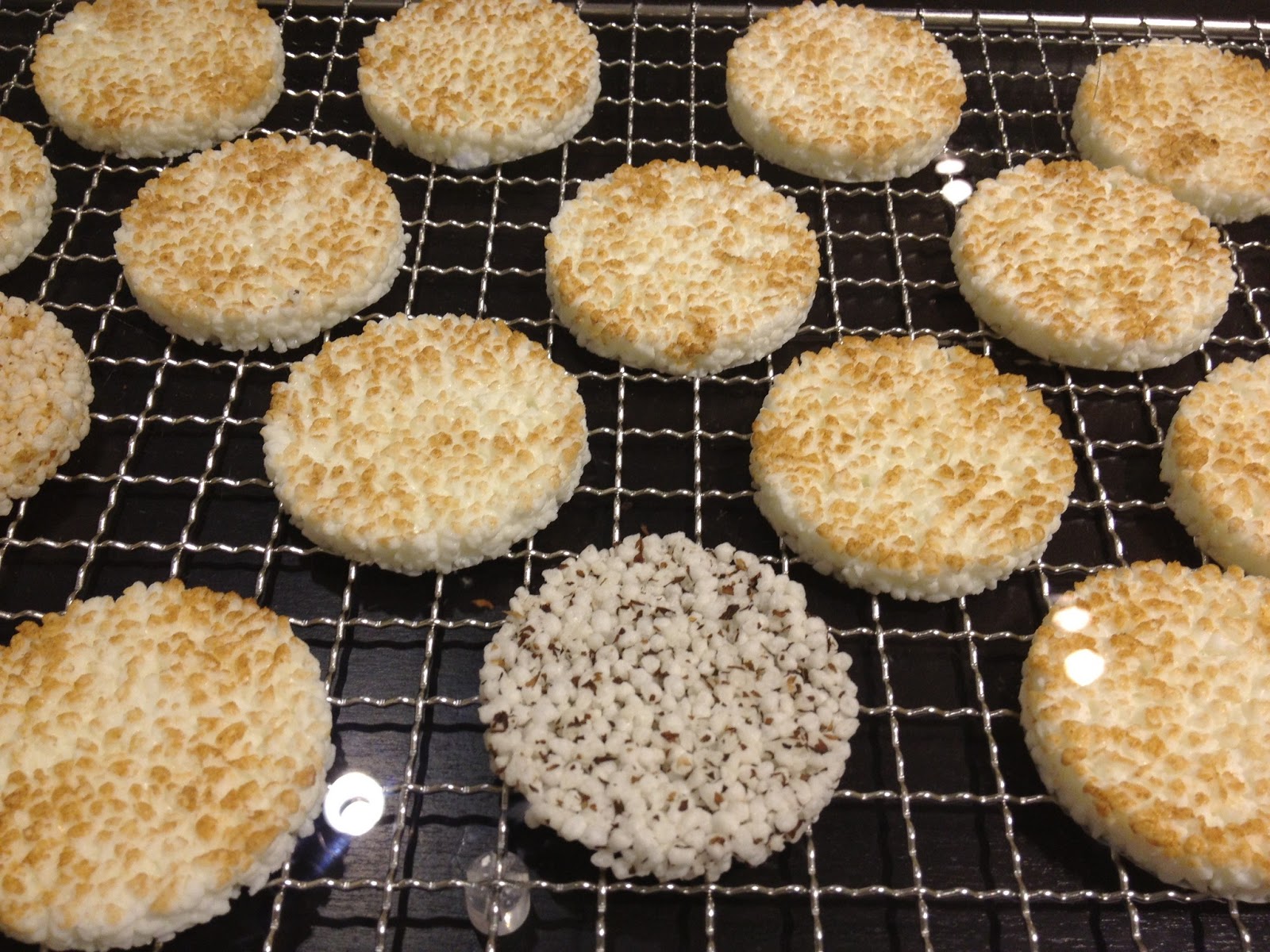
Here's a refined version of the puffed rice crackers that you can find in American health stores. 


International cuisines are not totally shunned, either. The shellfish in this paella kit looks better than anything you can  find in New York.

I learned a lot more on my tour, but this is probably more than enough for you. Thanks again for the great tour, Yukari!


May 28, 2013

In Tokyo, Mixologizing with the Seasons

Gen Yamamoto, ready for business.
One of the best parts of a highlight-filled trip to Tokyo recently was dropping in on Bar Gen Yamamoto. Gen joined David Bouley's New York City team in late 2010 and the following April helped open Brushstroke, Bouley's French-tinged play on kaiseki cuisine. There, he specialized in fruit- and vegetable-based cocktails that were remarkable for their elegance and subtlety. I was a fan in New York, and curious to see what new concoctions the gifted mixologist had up his freshly-pressed sleeve in Tokyo.

He's set up his welcoming eight-seat bar in Azabu-Juban, a neighborhood where remnants of old Japan collide with  embassies, cafes and an international mix of residents. To the delight of his followers, he's also extended his range with a cocktail list that serves as a guide to the agrarian bounty of his native country.

We tried a four-course tasting menu (¥4,200, six-course is ¥5,800) which started with a refreshing mix of cucumber from Ibaraki, Kumamoto cantaloupe, Okinawa hiba-chi pepper, and Kawabe rice shochu. The latter is from a region in Kumamoto Prefecture known for its pristine waters.

 Fruit opener: cucumber, cantaloupe, hiba-chi pepper, rice shochu.

Full of beans: Ehime fava, kinome, junmai ginjo Raifuku.

Excited about the range of produce he has access to from all over Japan, Gen raves about the softness the tomato water he extracts from Ishiyama tomatoes that are now in season. He pays close attention to the condition of each tomato, and depending on variables such as when in the season they are picked and when in the tasting service he places it, he may use one of seven different tomato cocktail recipes. "The main thing is that I'm always looking for improvement and trying to surprise my guests," he says. The one we sampled included both fresh tomato, a housemade confiture of tomato, shiso and Rives Spanish gin. 


Not your mom's bloody Mary: Tomato cocktail

Another of Gen's finds is raw Kumano dogwood honey. The trees' flowers produce enough honey for bees to collect only every four years, resulting in a denseness of flavor that he likes combined with Ehime new summer orange (the flavor of which is somewhere between yuzu, grapefruit and lemon), mint and Torikai rice shochu.

The "dessert" course: summer orange, Kumano honey, mint, rice shochu 

Gen himself brings to mind a latter-day Jeeves, an unflappable master of his trade who never seems to break a sweat. While he is tall and lean, however, his creations are uniquely round and soft. They don't deliver the blunt alcoholic KO that many drinkers seek, but creep up on you in stockinged feet; their impact can therefore come as a surprise at the end of the evening. 

The room Gen has created is remarkable as well, anchored by an beautiful, broad bar fashioned from a 500-year-old Japanese oak (mizunara) tree. Beige walls and minimal adornment complete the setting, making Bar Gen Yamamoto a soothing refuge where you can relax and converse with your fellow guests and host while sampling his quietly astonishing cocktails.

Bar Gen Yamamoto
1-6-4 Azabu-Juban
Minato-ku Tokyo 
03-6434-0652
website: www.genyamamoto.jp


May 1, 2010

NYC Takashimaya gone; the real thing beckons

Just as I was mourning the closing of the gorgeous Fifth Avenue branch of the Japanese department store Takashimaya, a beautiful and mouth-watering book arrived on my desk. Titled Food Saké Tokyo, it is written by a former Takashimaya depachika (food hall) employee, Japanese-American chef, sommelier and journalist Yukari Sakamoto.

As I flipped through the book, nostalgic memories of our satellite Takashimaya, with its once-delicious Tea Box restaurant, tea counter, Yokumoku cookies and raffiné Japanese ceramics began to seem paltry compared to Sakamoto’s dissection of the real thing: the Tokyo depachika. A combination of the words depā-to (department store) and chika (basement), these underground food extravaganzas are a something like a cross between Chelsea Market and Bergdorf’s, but with many more specialty food shops—pickles, saké, Japanese and western confections, meat, chocolate, to name just a few—representing the best edible and potables the country and world have to offer.

There are many other pleasures to be found in this handy guidebook, which is part of The Little Bookroom’s Terroir series (other volumes in the series include food and drink guides to Burgundy, Rome and Budapest). Filled with hunger-inducing photos, Food Saké Tokyo is aimed at the gastro-tourist who wants to know where to find the best, whether it is miso, senbei crackers, kaiseki (a style of dining composed of an artful parade of small plates) or an inexpensive bowl of ramen. It also includes useful tips on dining etiquette (never let your companion’s beer or saké glass go empty), primers on the Japanese vocabulary of food and drink and listings by neighborhood.

I loved the page that defines food and drink-related giongo and gitaigo, onomatopoeic double words that meld taste, feel, sound and language into a sensory-descriptive whole that English utterly lacks. For example, a bowl of hot, steaming rice is hoka hoka; koto koto is the sound a bubbling pot makes and the stickiness of natto (fermented soybeans) is neba neba.

It’s been years since I lived and worked in Japan and regularly trawled the depachika for unusual foods. When I return for a visit next year, Food Saké Tokyo will be in my suitcase, and I’ll have a pretty good idea of where and what I’ll be eating.