Showing posts with label Japan. Show all posts

March 21, 2014

In Spain, an Ancient Japanese Fish Processing Technique


In America we know it as the imitation crab stick of the California roll. In Japan it commonly appears as kamaboko (fish cake), and in China as fish balls. I'm talking about surimi, a resourceful product that makes use of fish protein that would otherwise go to waste. It came as a surprise, though, to find surimi being hawked in Madrid's Mercado de San Miguel.


There, I came across a food cart run by Ale Vin Cocina Creativa, selling surimi in the form of gulas, short for angulas. These are the tiny, two-inch-long elver eels that they resemble, which are much loved by Basques but in dwindling supply.  It all made more sense after reading this 1994 New York Times article  by Mark Kurlansky. Back then, Basques looked upon these imitation gulas with suspicion, checking to see if the worm-like creatures had faces on them before partaking. Funny, since many Americans would have the opposite problem, finding it hard to each something that small with a face.

Gulas are traditionally served with olive oil, garlic and peppers;
these are garlic flavored. 

Gula tapas.
Twenty years after Kurlanskly wrote this article, though, these surimi gulas are now taken for granted as a necessity and a form of sustainable fishing and eating. This article describes a new partnership to create gulas from Norwegian salmon. As the explanatory placard at Ale Vin's cart describes, making these faux gulas harnesses "an ancient technique from Japan." White meat from five Alaska pollock become a kilogram of gula surimi through that addition of color and flavor, and after, I assume, the paste is extruded into gula look-alike shapes. The result: "Pure fish protein with high nutritional value."


May 20, 2013

My Japan Airlines Foot Massage

I haven't flown Japan Airlines in a long time, so had not seen this particular airborne customer perk before. At the back of the plane en route to Tokyo,  where all the parents with jumpy kids and restless adults mill about during the 13-hour flight, this reflexology map of the foot was posted:


Right below it, I found this bamboo segment, upon which you massage the above outlined pressure points.


I had to wait in line for my turn, and when I hopped on the bamboo half-cylinder, found that it can be a challenge to zero in on minute points such as  #4 and #5. I  did my best, though, and my organs and other bodily parts thanked me for my efforts. Since my total travel time to Saga Prefecture, Kyushu was 25 hours, I can only imagine what kind of shape I would have been in at trip's end without this ki-enhancing interlude.


April 5, 2012

Japan Has Always Been About Seasonality

On my recent trip to Japan I was once again enthralled by the joy everyone there takes in the newest produce of the season. American chefs and dedicated eaters like to talk about "seasonality" but in Japan the love for what's at its peak is embedded in the culture. There's even a term, hatsumono, for the first harvest of the season, specifying foods to be delighted in and gorged on for those first days when they are at their peak.

In summer the craze is for first-harvest white peaches, in August for new rice, and in fall for persimmons. When I was there in late March, I saw ichigo daifuku, or azuki bean-filled rice cakes filled with delicious new strawberries everywhere (the strawberries in Japan taste different from U.S. varieties, smaller and more intense in flavor). The country was also starting to vibrate in anticipation of the annual cherry blossom season, which is celebrated in drink, song, blossom-viewing parties and all manner of sakura-themed and -flavored foods.


There was my favorite sakura-mochi, another type of rice cake tinted pink and wrapped in a salty preserved cherry leaf. I had a wonderful, pinkish sakura soba at the luxurious hot springs resort Hakone Ginyu, to which powdered cherry petals had been added. Even Krispy Kreme Japan got into the act, advertising its "Sakura Dozen" doughnuts with pink-tinted icing.

My favorite hatsumono, though were the freshly dug bamboo shoots (takenoko) that appeared everywhere. At once delicate, crunchy and mildly aromatic, new harvest shoots are far superior to the hard, metallic-tasting canned variety. One of the most delicious preparations I tried was at Sakagawa restaurant in Kyoto's Gion district. There, very large rounds were cut into wedges, basted with a tare, or soy-saké-mirin grilling sauce, cooked in front of counter guests over a clay hibachi, then garnished with aromatic kinome (Japanese pepper) leaves.

Buddhist vegetarian feast, with bamboo shoot at upper left.


Then there was the unbelievably fresh bamboo shoot I had as part of this Buddhist vegetarian shōjin ryori lunch at the ancient Zen temple Tenryū-ji. When I complimented the cook, she beamed and told me it was freshly dug.


Look hard, takenoko in upper right-hand corner!

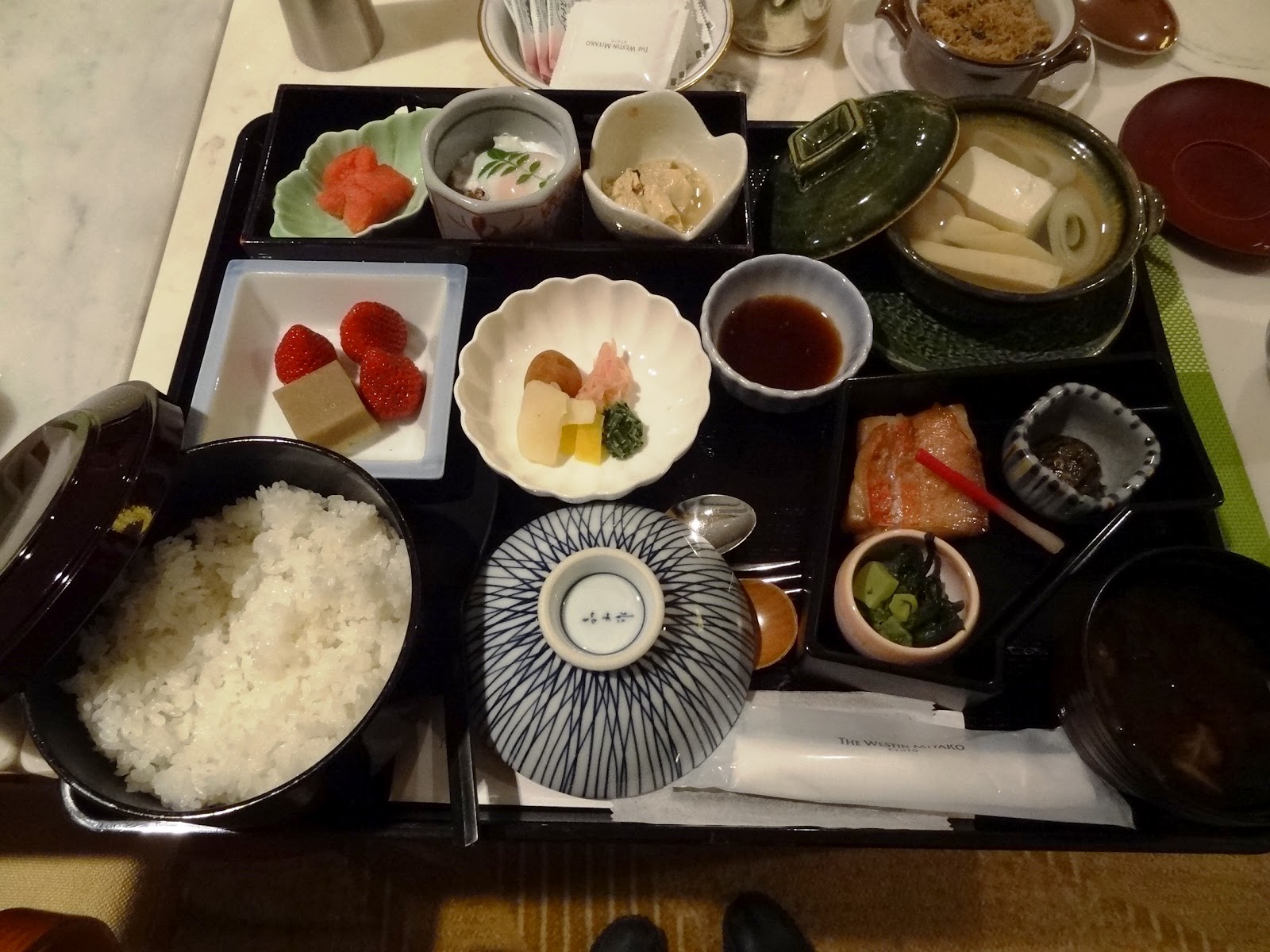
Takenoko  showed up in my Japanese -style breakfast at the Westin Miyako hotel, in a warm crock of simmered tofu (yudōfu). 

Easy to spot here.


Finally, there was this lovely, steaming bowl of simply prepared soup at the kaiseki restaurant Jiki Miyazawa: a clear broth with wakame seaweed and beautful bamboo shoots, garnished with the ubiquitous kinome leaf.

Now I'm hankering to visit Japan in the fall, to enjoy a whole different set of hatsumono.