April 27, 2012

A Taste of Hawaii in Torrance


On my recent trip to California, Vicky Murakami-Tsuda of the Japanese American National Museum in Los Angeles suggested meeting for breakfast at The Local Place in Torrance. Little did I know that she was about to trigger a little memory cascade. It turns out that the cafe-bakery with the very humble name is owned by King's Hawaiian, whose fluffy Portuguese sweet bread was a ubiquitous part of growing up in Japanese American Southern California. It comes in single round loaves or pull-apart rolls, is great toasted with butter, and, along with those Portuguese-style egg custard cakes sold in Chinese bakeries, has to rank among Portugal's great culinary contributions to Asia and now America.


I knew that the bread was popular in Hawaii, where the company is based, but until Vicky pointed me to this article on DiscoverNikkei.org, I didn't know that it was started and owned by an Okinawan American living in Hilo named Robert Taira. Here's a picture of the original Honolulu coffee shop and bakery in 1968, which hangs on the wall at The Local Place.

The cafe/bakery is the smaller offshoot of the first Torrance King's Hawaiian, but features the same Portuguese sweet bread French toast, as well as Japanese American classics such as Spam-and-egg musubi (rice balls). Spam is in fact featured in everything from breakfast sandwiches to burritos, and is evidence of the Japanese American culinary version of Stockholm Syndrome: you grow to love the food your budget and upbringing put in front of you. There are also great Hawaiian Japanese combinations such as The Local Scramble, scrambled eggs, char siu pork, kamaboko (bamboo shoots), green onions and cheese. 

The Local Place and King's Hawaiian are also famous among Japanese Americans for their Hawaiian Paradise chiffon cake, layered with guava, passion fruit and lime filling and frosted with whipped cream. I had to take one of these home with me! 


April 9, 2012

Elizabeth Andoh Pays Culinary Tribute to the People of Tohoku


The esteemed Japanese cookbook author Elizabeth Andoh made an appearance tonight at The International Culinary Center in Soho to talk about her new e-book, Kibo, a culinary tribute to the people and foodways of Tohoku, Japan.

The area is still reeling from the quake-tsunami-nuclear disaster of March 11, 2011, and Andoh will be donating half of the proceeds from the book to relief and recovery efforts. "Food and culture disappear under stress," she told the audience, and so she wanted to capture the food culture of the region "before it morphed into something unrecognizable."

I had never met Andoh before, even though I was a religious reader of her Japan Times column when I lived in Tokyo. I vaguely recall someone telling me that although she is a Caucasian American, forty-plus years in Japan have given her a somewhat Japanese appearance. She did indeed seem Japanese, not just in manner and clothing, but physically as well, perhaps because of the way she pulled her hair back in a bun, or her extreme graciousness.


Some of the truly distinctive Tohoku dishes Andoh introduced were a shiso maki, thin, cylindrical shiso leaf packets stuffed with a walnut-miso paste; a salad made of dried yellow chrysanthemum petals and enoki mushroom; a sweet shira-ae, of fresh apple and dried apricots and cranberries dressed with a pine nut-and-tofu mixture, and what she described as a "funky, funky"  ika ninjin, or squid jerky and julienned carrot strips simmered in vinegar, brown sugar, and hot pepper. All of them were delicious, and completely different from versions of these dishes that I grew up with.

To pair with these tantalizing morsels were three impressive saké samplings that Timothy Sullivan of UrbanSaké.com (he was a great source for my Edible Manhattan saké story) introduced: Nanbu Bijin Tokubetsu Junmai, Daishichi Kimoto Junmai and Urakasumi Zen from the disaster-affected prefectures of Iwate, Fukushima and Miyagi.

Andoh noted that her Japanese cookbook colleagues were puzzled by her desire to talk to the devastated people of Tohoku about their food traditions, and later told me that their incomprehension "made me realize how American I am." It's also in her nature to want to study these things; she was trained as an anthropologist at the University of Michigan before, on a lark, applying for a scholarship to study in Japan, a country she knew nothing about.


Thanks to Yukari Sakamoto, author of the wonderful Food, Sake Tokyo for alerting me to tonight's event!

April 5, 2012

Japan Has Always Been About Seasonality

On my recent trip to Japan I was once again enthralled by the joy everyone there takes in the newest produce of the season. American chefs and dedicated eaters like to talk about "seasonality" but in Japan the love for what's at its peak is embedded in the culture. There's even a term, hatsumono, for the first harvest of the season, specifying foods to be delighted in and gorged on for those first days when they are at their peak.

In summer the craze is for first-harvest white peaches, in August for new rice, and in fall for persimmons. When I was there in late March, I saw ichigo daifuku, or azuki bean-filled rice cakes filled with delicious new strawberries everywhere (the strawberries in Japan taste different from U.S. varieties, smaller and more intense in flavor). The country was also starting to vibrate in anticipation of the annual cherry blossom season, which is celebrated in drink, song, blossom-viewing parties and all manner of sakura-themed and -flavored foods.


There was my favorite sakura-mochi, another type of rice cake tinted pink and wrapped in a salty preserved cherry leaf. I had a wonderful, pinkish sakura soba at the luxurious hot springs resort Hakone Ginyu, to which powdered cherry petals had been added. Even Krispy Kreme Japan got into the act, advertising its "Sakura Dozen" doughnuts with pink-tinted icing.

My favorite hatsumono, though were the freshly dug bamboo shoots (takenoko) that appeared everywhere. At once delicate, crunchy and mildly aromatic, new harvest shoots are far superior to the hard, metallic-tasting canned variety. One of the most delicious preparations I tried was at Sakagawa restaurant in Kyoto's Gion district. There, very large rounds were cut into wedges, basted with a tare, or soy-saké-mirin grilling sauce, cooked in front of counter guests over a clay hibachi, then garnished with aromatic kinome (Japanese pepper) leaves.

Buddhist vegetarian feast, with bamboo shoot at upper left.


Then there was the unbelievably fresh bamboo shoot I had as part of this Buddhist vegetarian shōjin ryori lunch at the ancient Zen temple Tenryū-ji. When I complimented the cook, she beamed and told me it was freshly dug.


Look hard, takenoko in upper right-hand corner!

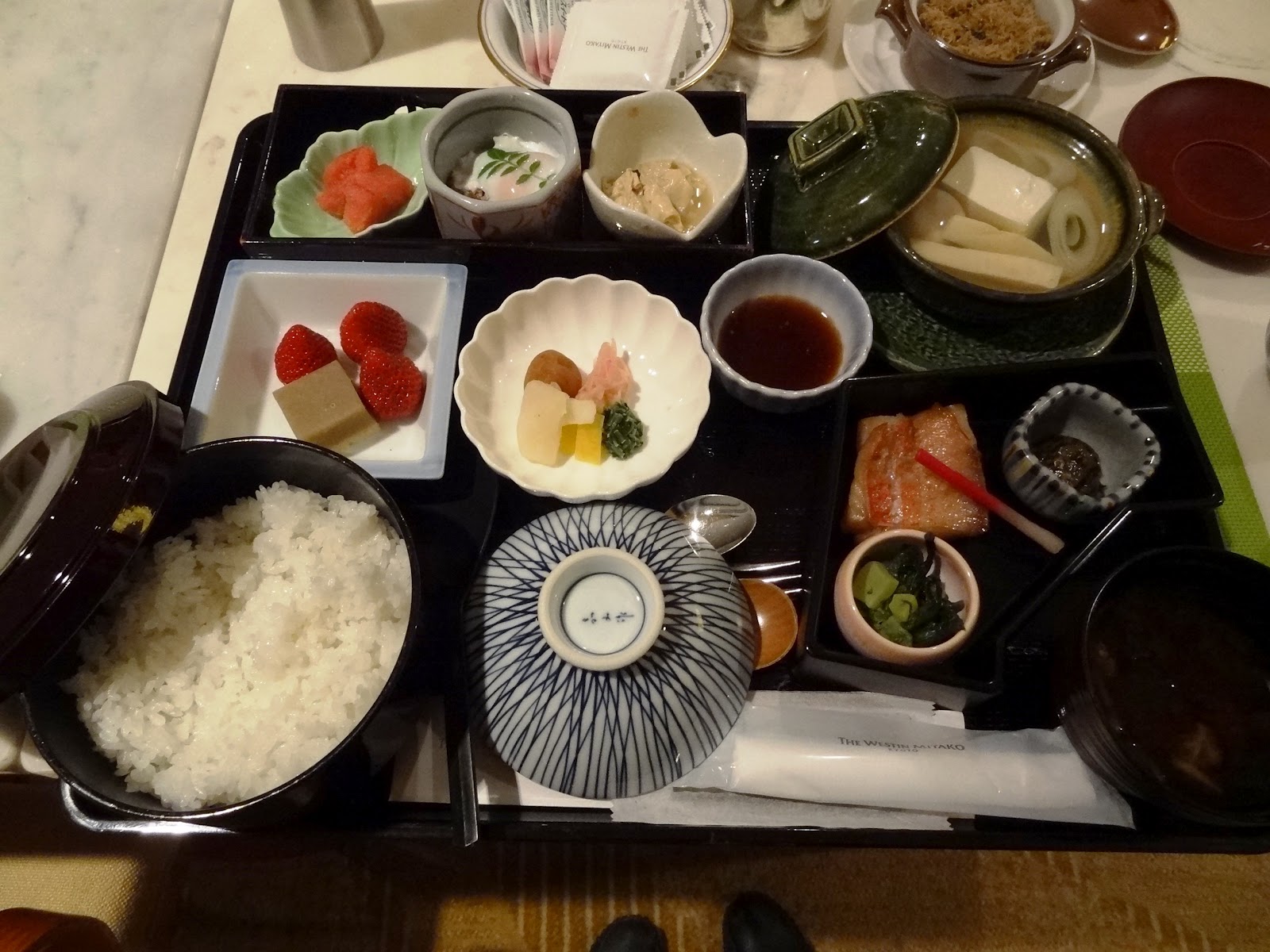
Takenoko  showed up in my Japanese -style breakfast at the Westin Miyako hotel, in a warm crock of simmered tofu (yudōfu). 

Easy to spot here.


Finally, there was this lovely, steaming bowl of simply prepared soup at the kaiseki restaurant Jiki Miyazawa: a clear broth with wakame seaweed and beautful bamboo shoots, garnished with the ubiquitous kinome leaf.

Now I'm hankering to visit Japan in the fall, to enjoy a whole different set of hatsumono.  


April 2, 2012

Charcuterie at Epicerie Boulud


One of the Manhattan places I most wish I lived next door to is Épicerie Boulud, the Upper West Side shop that, like my favorite Vancouver patisserie/chocolaterie/ café , Thierry, transports the visitor to Paris immediately upon entrance. Épicerie, as its name implies, is even broader in scope than Thierry, offering a full line of take-out food and catering for anything from a  picnic in Central Park to a swanky penthouse party. Among the highlights of the shop's offering are the amazing creations of master charcutier Gilles Vérot.


Vérot and his boss, chef Daniel Boulud, were on hand today to introduce their spring "collection" (the aspirational term for runway-worthy edibles) of charcuterie. Among them is a springtime Rillette Provençal with pork jarret (knuckle), tomato, zucchini, eggplant and basil. (Quick primer: pâtés are mechanically ground and sometime wrapped in a rich pastry to make them en brioche; terrines are coarser, featuring hand-ground meats, while the rillette contains meat that has been cubed or chopped and is usually cooked slowly in fat.)


To make his spring rillette lighter than its winter counterpart, instead of cooking the meat in its own fat, Vérot replaces the pork fat with a mix of juices from the meat and olive oil. He suggests pairing a slice of the  Rillette Provençal with a mesclun or other green salad and eating it as a main course instead of as the first course of a heavier wintertime meal.


A third-generation charcutier, Vérot also runs two Paris charcuterie boutiques with his wife Catherine, supplying individual customers and a select group of restaurants, including the very popular wine shop-restaurant Le Verre Volé. He and Catherine have a cookbook coming out in the fall, too, both in French and English. When I left l'Épicerie, Vérot was holding forth on how to make fromage de tête, or head cheese, of which he has been named the French champion maker. So if this is next on your DIY list, queue up and look for his book come fall!


Épicerie Boulud
1900 Broadway at 64th St.
New York, NY 
212 595 9606

March 15, 2012

Visit to Flushing, Queens Chinatown

Touring Chinatowns with Buddakan Co-Executive Chef Yang Huang has become a habit that we can't seem to break. Since we've already visited those in Brooklyn and Manhattan for Edible articles, Yang suggested we check out their Queens counterpart, centered on the terminus of the Number 7 line at Main Street and Roosevelt Avenue.


So along with his new bride Christy (they were married in September before 400 family members and friends) and Buddakan wok chef Mr. Lee, we took our empty stomachs to Flushing.

At our first stop, the humongous Grand Restaurant, on the third floor of the shiny New World Mall, we sampled a selection of dim sum, including some perfectly prepared shrimp hargow, my favorite pork wrapped in yuba skin, and beef siu mai. There were also marinated and steamed chicken feet and beef tripe in a soy-based sauce, which Westerners and Japanese almost never order, and which I consider a rare treat when I'm with an all-Chinese group.


The most novel dishes to me, though, were three desserts that Christy ordered, a silky sweet pumpkin and corn soup; a red bean, coconut milk and rice flour squares that were in texture like a cross between flan and chiffon pie, and an amazing lao sa bao. The white bao look like pert Japanese azuki-filled manju, but are instead filled with a rich, oozy yellow filling made with butter, sugar, and custard powder, according to Yang. They are served steaming hot and because of their grainy texture, are known as "running sand" bao in Chinese.

The happy newlyweds, Yang and Christy.
(Retiring Mr. Lee had momentarily disappeared.)


After admiring the extensive seafood tanks at Grand Restaurant and meeting CEO Tim Cheng, we headed downstairs to a different kind of diner's paradise, the New World Mall food court. There, the highlight was a bowl of hand-pulled noodles swimming with beef in a dark broth from Lanzhou Handmade Noodle. Named for the capital city of Gansu Province in Northwestern China, where they are a specialty, these amazing noodles are endowed with an addictively perfect chewiness, a bite-to-resistance ratio that, on first taste, solves the mystery of the shop's renown.


And as if that weren't enough, Yang was determined to hit one more Flushing favorite, Corner 28, where we sat upstairs, watching bustling Main Street traffic below and crunching our way through the crispiest and most delicious version of this dish I've ever had.

Now that we've successfully invaded and taste-conquered three major Chinatowns in New York City, we've decided on our next goal: a Japanese izakaya, for rustic pub food and beer.  

March 9, 2012

Confession of Error: Justice Department Finally Admits it was Wrong in Hirabayashi v. United States


 In May 2011, Neal Katyal, then Acting Solicitor General of the U.S., issued a “confession of error” on behalf of his office for defending the mass government roundup and imprisonment of U.S. citizens and immigrants of Japanese descent during World War II.

Last night Katyal, who is now a law professor at Georgetown University and a partner in the firm Hogan Lovells, LLP, spoke about this confession of error in a talk at Fordham Law School. He described how in 1943 Solicitor General Charles Fahey had to defend the government’s actions when the appeal of conscientious objector Gordon Hirabayashi, who had been convicted of violating curfew during the earlier forced roundup, reached the Supreme Court. Although Fahey was aware of intelligence reports that found that the vast majority of Japanese Americans did not pose a security threat, he papered over that evidence, leading to the Court unanimously uphold  Hirabayashi’s conviction in June 1943. You can read a blog post Katyal wrote on the confession of error here.

In a way, Katyal’s talk was a tribute to Justice Department lawyers Charles Ennis and John Burling, who fought hard to “challenge the system from within” and urged Fahey not to fight Hirabayashi’s appeal and those of Fred Korematsu and Minoru Yasui, even as Fahey made “arguments that were products of their time.” After Assistant Attorney General and Columbia law professor Herbert Weschler drafted a footnote to the government’s brief fudging Justice’s position in order to prevent any accusations of suppression of evidence, Ennis and Burling reluctantly signed their names to it.
   
Katyal told the audience his “greatest regret” was that Hirabayashi did not receive the Presidential Medal of Freedom during this life time, as Korematsu was able to do. Since posthumous awards are sometimes given, Katyal added, “I would very much like to see that.”

The talk, directed at a hall full of law students and law professors, was a footnote to the story of the World War II incarceration, yet poignant and relevant as well. Katyal’s advice to current Justice Department officials prosecuting the war on terror: “Because the courts lack institutional competencies in war matters [Justice Department lawyers] have to make the most accurate briefs and have to explain their reasoning…their duty of candor means they have to be absolutely sure to tell every part of the story.” Let’s hope that the current staff in Washington heeds Katyal’s message.

March 1, 2012

Brustroke Kaiseki, Chef's Pass at Bouley


Two nights ago, I had the chance to visit Brushstroke, the very Japanese Tribeca kaiseki restaurant from chef David Bouley, in collaboration with the Tsuji Cooking Academy in Osaka, Japan. The joint effort goes back 18 years, when Bouley first met Tsuji presidentYoshiki Tsuji, whose father founded the school and authored the seminal Japanese cookbook Japanese Cooking: A Simple Art. In order to bring the spirit of Japanese cuisine to New York, professors from the academy, kitchen equipment, ingredients and ideas have wended their way from Japan to Tribeca, making Brushstroke possibly the most authentic Japanese dining experience you can have in New York City at the moment.

Bouley says the collaboration is an extension of the way he’s always thought about cooking. The Japanese like him, he noted, because he’s a farmer at heart and he’s been doing seasonally driven kaiseki-style dinners since 1985, when he served 12- and 15-course small plate dinners on  custom-made Limoges china.


The Brushstroke space (formerly Danube), designed by the Japanese firm Super Potato and its lead designer Takashi Sugimoto, is a honeyed, mellow space, one wall of which is composed of the page-ends of 2,500 books stacked in criss-cross patterns and tinted to mimic the natural striations of wood. Chef Isao Yamada and mixologist Gen Yamamoto are creating exciting dishes and drinks that feel cutting edge modern but with the fanatic attention to detail and technique of the best Japanese restaurants. Among the dishes we sampled: “stinky” and creamy fermented tofu; truffled chawan-mushi (savory egg custard) with sea urchin; lobster claw tempura with two kinds of salt, curry and green tea, and a selection of pristinely fresh sushi. 

The clean, clear flavors extend to Brushstroke's cocktail menu as well, where heirloom tomatoes, grapefruit, ginger and green peas have all found their way into Yamamoto’s inspired cocktails. My grape tomato concoction was a beautiful shade of pink-red, subtle and delicious.

Chef's Pass, photo by Nicole Bartelme

Back at Bouley, I got a peek at a room called the “Chef’s Pass.” In the process of expanding his kitchen space, the chef created a wondrous, salon-like room decorated with the kinds of gorgeous antique, artisanal and one-of-a-kind finds that he seems to amass in his sleep (he and chef Jody Williams are alike that way). The novelty is the 65-inch flat screen TV, where private dining groups can partake of their dinner while conversing, via Skype, with the purveyors who supply Bouley: master saké brewers in Japan, vintners and cheese makers in France and farmers in the Catskills or the Berkshires. Tours cheese maker Rodolphe Le Meunier, Meilleur Ouvrier de France (the highest honor awarded artisans in France), is such a good sport he’ll get up at 4 a.m. to chat with Bouley diners and explain his methods.

Chef's Pass allows Bouley to educate his patrons while feeding them in style, to introduce the hard-working farmers and craftspeople who make his kind of restaurant possible. Yet the chef takes a jaundiced view of the current “farm-to-table” movement, saying, “it’s what farmers have been doing for ten generations where I grew up in New England." While this "reinvention" of age old practices is nothing new, "it's a good thing," he adds, because it brings home the message that "people should not underestimate the value of the farmer."