March 27, 2014

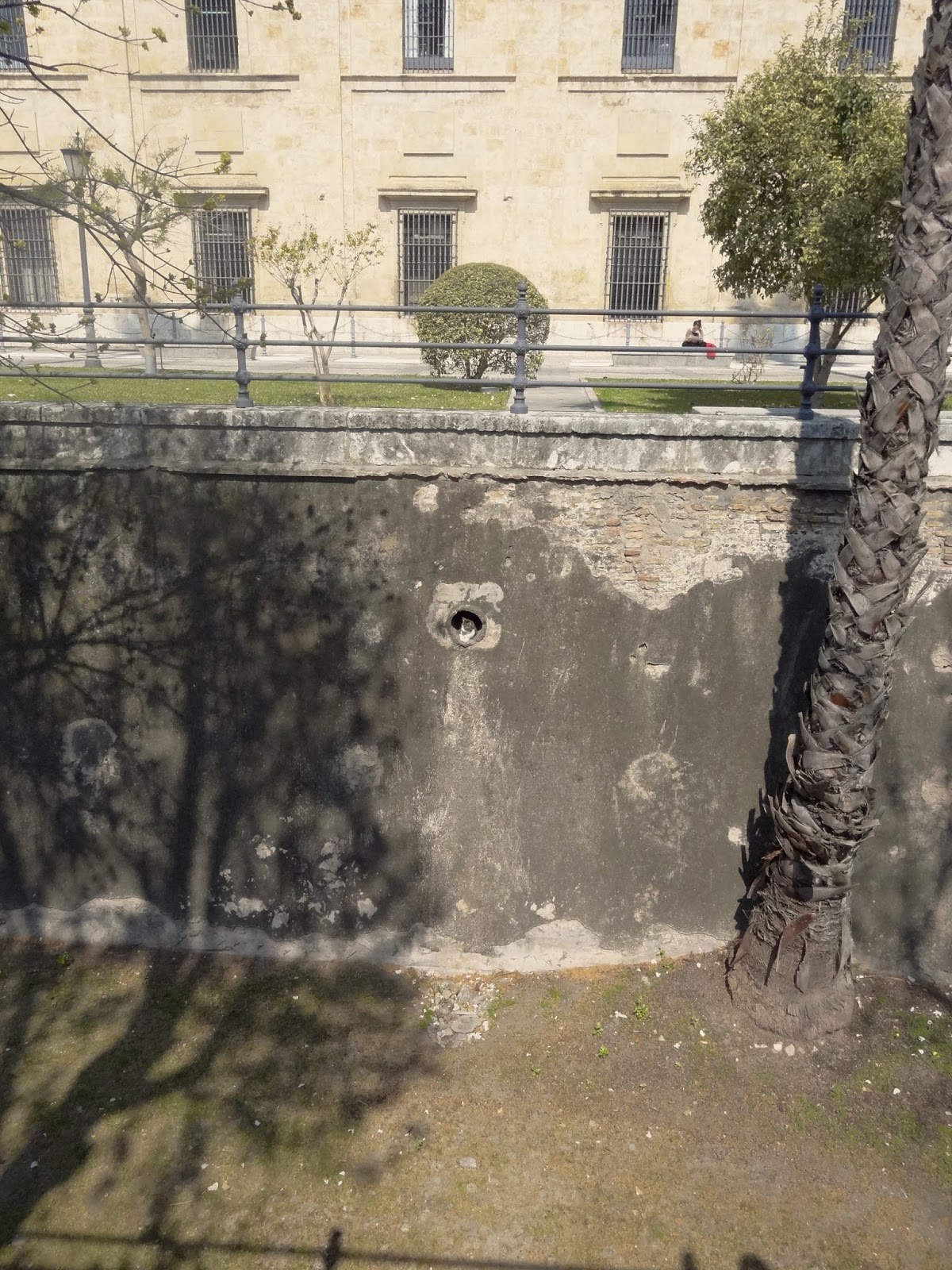
Spanish Cat Shows Off Talent for Camo

So we were walking along the back side of one of the buildings of the University of Seville when we spotted this cat, cleverly camouflaged as it sunned itself at the end of a drain pipe in a moat wall.


The moat once protected the beautiful building above it, erected during the 18th century to house the Real Fabrica de Tabacos (Royal Tobacco Factory). There, three-quarters of Europe's cigars were rolled on the thighs of more than 3,000 impertinent cigarreras (female cigar-makers), our guidebook informed us.


The moat and the building's watchtowers are proof of how much those cigars were worth. Now, though, the moat is dry and this kitty probably thinks its main function it to protect her prime lounging nook. The below photo gives you a sense of splendid isolation and noblesse oblige she must feel when installed there; she's the real winner of the Spanish War of Succession.  


March 22, 2014

In Andalusia, On the Hunt for Salmorejo

I'm in Andalusia, Spain now, soaking in some much-needed sun and discovering the joys of salmorejo. It's a delicious local version of gazpacho, the color of a Creamsicle and blended smooth and thick as a good milkshake. This dish is savory, though, made with very ripe tomatoes, bread, extra-virgin olive oil, Jerez sherry vinegar, and garlic.

Originally from Cordoba, salmorejo appears on menus across Andalusia. I've loved each version of this cold, refreshing soup that I've tried. At one charming patio restaurant in the old Jewish quarter of Seville, our waitress came by to sprinkle the top of our salmorejo with chopped onions, tomatoes and red peppers.


The San Fernando restaurant at the Hotel Alfonso XIII in Seville makes this classic version, which comes topped with hard boiled egg, the yolks and whites separated into neat opposing quadrants, along with chopped tomatoes and black olives. Finishing the dish are shards of crispy cured and dried Iberico ham.

San Fernando sommelier Gregory Bossuyt notes that sometimes salmorejo comes topped with pieces of dried tuna instead of ham, or for vegetarians, with diced red and yellow peppers and cucumber.

At the Marbella Club Hotel in Marbella, the salmorejo was
 lighter in texture and heavier on the vinegar.

Chef Jorge Manfredi's take on the salmorejo
 at DMercao, Seville.  

The most adventurous and unusual salmorejo that I tried was at the tapas restaurant DMercao, where Chef Jorge Manfredi liberally mixes Japanese techniques and ingredients with classic Andalusian products. The first course of a highly inventive tasting menu we tried was a orange salmorejo, garnished with an umami-bomb of a tuna confit cigarillo.

Manfredi says that this dish is a version of a salmorejo that won him third place in the Jornadas Gastronomicas de la Naranja, a competition that began as a way to encourage local chefs to use the ubiquitous bitter Seville orange that now hang heavy on trees throughout the city. Most of them end up as exports to England, where they will be boiled into submission and turned into the Seville orange marmalade so beloved there.

His prize-winning orange salmorejo, Manfredi, says, was made with the juice of the Seville orange and topped with flaked bacalao (dried salt cod) and frizzled leeks.

Chef Manfredi was kind enough to share his recipe for the salmorejo he made for us. If you make it at home, try pairing it, as Manfredi does, with a pale and delicate Manzanilla sherry. You'll have the makings of your own Andalusian experience.

Orange Salmorejo with Tuna Kikkoman

For the salmorejo:

1 liter fresh-squeezed orange juice
300 grams of white bread
1 clove garlic
a bit of water
Salt and sugar to taste

For the Tuna Confit Kikkoman:

130 grams fresh tuna, vacuum sealed cooked at 140 degrees fahrenheit for 30 minutes
Store-bought spring roll or won ton wrapper
Carrot
Leek
Kikkoman soy sauce
1 egg, beaten

Preparation:

For the salmorejo: combine all ingredients in a blender for six minutes. Strain and refrigerate. It should be fluffy and soft on the palate.

For the tuna: Finely chop the leek and carrot. In a bowl mix the tuna, carrot and leek. Season with soy sauce to taste. Fill and roll the won ton wrapper with tuna and roll into a baton shape. Seal with a little beaten egg. Fry in 338-degree fahrenheit oil.

To finish: 


Fill a cocktail glass with orange salmorejo and garnish with the Kikkoman baton. 


March 21, 2014

In Spain, an Ancient Japanese Fish Processing Technique


In America we know it as the imitation crab stick of the California roll. In Japan it commonly appears as kamaboko (fish cake), and in China as fish balls. I'm talking about surimi, a resourceful product that makes use of fish protein that would otherwise go to waste. It came as a surprise, though, to find surimi being hawked in Madrid's Mercado de San Miguel.


There, I came across a food cart run by Ale Vin Cocina Creativa, selling surimi in the form of gulas, short for angulas. These are the tiny, two-inch-long elver eels that they resemble, which are much loved by Basques but in dwindling supply.  It all made more sense after reading this 1994 New York Times article  by Mark Kurlansky. Back then, Basques looked upon these imitation gulas with suspicion, checking to see if the worm-like creatures had faces on them before partaking. Funny, since many Americans would have the opposite problem, finding it hard to each something that small with a face.

Gulas are traditionally served with olive oil, garlic and peppers;
these are garlic flavored. 

Gula tapas.
Twenty years after Kurlanskly wrote this article, though, these surimi gulas are now taken for granted as a necessity and a form of sustainable fishing and eating. This article describes a new partnership to create gulas from Norwegian salmon. As the explanatory placard at Ale Vin's cart describes, making these faux gulas harnesses "an ancient technique from Japan." White meat from five Alaska pollock become a kilogram of gula surimi through that addition of color and flavor, and after, I assume, the paste is extruded into gula look-alike shapes. The result: "Pure fish protein with high nutritional value."


March 10, 2014

Victory and Defeat on the Latte Art Championship 2014 Stage

Both Smith and Soeder opted for the tulip design.
I'm not a latte drinker myself, but I like to look at them. They have become so beautiful, with those swirly espresso-and-white patterns reminiscent of flowers, hearts, cute animals, snowflakes, runic symbols, what have you. So when I found out that New York was holding its own Latte Art Championship at CoffeeFest over the weekend, I had to stop by.

I wasn't there for the climactic moment, when apparent latte art genius Cabell Tice (even his name sounds artisanal!) of The Thinking Cup in Boston nabbed the title, reprising his win last year in Seattle. But I was there for a poignant moment on the second day of competition when the pool of 32 was whittled down to 16.  It came when Ryan Soeder of Intelligentsia Chicago went head-to-head against and edged out competitor Kenny Smith of Sunergos in Louisville, Kentucky.

By finishing first in the three-minute competition Soeder immediately had the edge in scoring. The judges also gave the advantage to him in two other scoring categories: color definition (how white is the white and how brown is the brown) and infusion (swirliness). Yet at least one judge felt Smith got the better marks in beauty and balance.

Smith, left, with former mentee Soeder. 
Immediately after their round, the two competitors stood and chatted. They were unusually friendly for competitors, it seemed to me, with Soeder complimenting Smith on his beautiful entry, and obviously feeling somewhat abashed at his win. It made sense when Soeder told me, "I learned latte art in Kenny's kitchen in Louisville." The two had dreamed of barista greatness, but "there was no one in the city to look up to," he added. "We had to look online, and we constantly egged each other on."

It happens in every pursuit, that moment when student surpasses master, and Smith was gracious in defeat. I hope that he was able to feel a sense of pride in having nurtured a talent that, at least on that day, outshone him. For every win, there is a defeat, though; Soeder got knocked out in the next round by Tokyo's Tsusaka Koike.


February 26, 2014

Charting the Future of the Japanese American National Museum

How does the Japanese American National Museum (JANM) stay relevant  as the torch passes from its founding Nisei members to Sansei, Yonsei, and beyond?

Last night, Dr. Greg Kimura, president and CEO of JANM, spoke to members of JAJA (Japanese Americans and Japanese in America) and told the group how he's planning to do that.

The L.A.-based JANM started largely as a way to tell the story of the illegal roundup and imprisonment of Japanese Americans during World War II. Now Dr. Kimura, says, the museum is faced with a choice: it can recede from the public eye and become a gathering place for Nisei old-timers, or enlarge its vision and mission and begin speaking to Nikkei of all ages, Millennials and the larger community.

With close to 1.5 million people of Japanese descent living in the United States, he said, many of them mixed-race people who take their status as full-blooded Americans for granted, the issue is no longer one of assimilation or proving they belong in America. Instead, it's "How do we incorporate what it means to be of Japanese descent in the search for identity?"

JANM's challenge mirrors that of many traditionally Japanese American organizations that are trying to survive as fourth-, fifth- and sixth-generation community members become more assimilated; the discussion brought to mind stories I heard when I wrote this Discover Nikkei series on the future Japanese American elder care on the West Coast.

Dr. Kimura, a fourth-generation Japanese American hapa and fourth-generation Alaskan, added, "Nowadays, I like to say in an increasingly globalized culture, everyone is hapa."

Instead of drawn-out discussions on whether the World War II U.S. government camps should be called "internment" camps or "concentration camps," Dr. Kimura's mantra is "taking people where they are in their understanding," in other words, being less pedantic and more inclusive.

So he's lined up a series of shows designed to draw in viewers of all stripes, addressing the most universally appealing aspects of Japanese American culture. Included on his roster is a show opening on March 8, "Perserverence: Japanese Tattoo Tradition in a Modern World." Another show (which by the way did not go over well among this group of New York City JAs) is planned on the role of the Los Angeles Dodgers in promoting diversity, which will feature Jackie Robinson, Hideo Nomo, Chan Ho Park, Sandy Koufax and Fernando Valenzuela. An October 2014 exhibit will celebrate the 40th anniversary celebration of Hello Kitty.

Dr. Kimura pointed to one model of the type of outreach he'd like to do: the $560 million Japanese government-backed Cool Japan Fund Inc., which has identified the "coolest" and most exportable aspects of its culture: food, fashion, manga, anime and pop music. "Cool Japan," he noted, "is the entree into Millenials and younger."

Although it took a high-priced branding group, acting as pro bono advisors to JANM, to tell the museum what its mission should be, Dr. Kimura said the message was simple: "We have to tell a different story for a different generation." 

February 13, 2014

The Tyranny of Urban Compost Collection


Life can get busy, and sometimes it's hard to find time to do the things I like, for instance going to the greenmarket. Ever since I started saving compostable food scraps, though, those trips are no longer optional, they're mandatory.

Earth Matter compost center on Governor's Island.
Photo by Valery Rizzo.
Why? Because I freeze my compost material until I can deposit my bags at one of Grow NYC's convenient market drop-off points.  If I can't get to the market for over a week, my family begins to balk at the spillover bags that start crowding the refrigerator, squishy intruders that offend sensitive fridge gropers.

Meredith Hill and friend.
Photo by Valery Rizzo.
The person I blame for this dilemma is Meredith Hill, a Pied Piper-like middle school teacher at Columbia Secondary School for Math, Science and Engineering. She's at the center of my article on urban composting in the current issue of Organic Gardening.  Meredith had her kids study the young reader's edition of The Omnivore's Dilemma and not only got them hooked on composting and gardening but turned them into vegetable lovers, too. (Kudos, Meredith! You've gone where many parents can only dream of going.)

Hill's class in their compost-rich organic garden on Amsterdam Avenue.
Photo by Valery Rizzo. 
I accompanied Hill on an expedition she led to a "chicken composting celebration" held in conjunction with the compost education organization Earth Matter, which processes 1,000 pounds of waste a week and turns it into compost. The event reunited Hill's students with six chickens they took care of at school for over a month as they learned about the virtuous cycle of food scraps (which the chickens feed on and augment with their nitrogen-rich droppings) transformed into food (eggs) and then compost.

Reunited: Student and chickens; Nigale Fofana reads her ode to chicks.
Photo by Valery Rizzo.
If you're wondering why middle schoolers get to have all the fun, read to the end of my article where I offer tips on how you, too,  can start your own community compost group.

Photographer Valery Rizzo shot awesome photos for the story, some of which I'm featuring in this post. For the rest of her favorite shots from the piece, check out this blog post from Valery.


January 22, 2014

Shingo Gokan: Playing with Fire and Vodka

Monday night I learned just how a mixologist and chef working together can create a dazzling ensemble performance. Behind the bar was Shingo Gokan, who directs the cocktail program at Angel's Share in the East Village and has been in demand for guest bar-tending gigs and master classes around the world since winning a Bacardi global cocktail competition in 2012. Invisible until his curtain call at the end of the night was the man working the kitchen, Chef Takanori Akiyama of Saka-Mai on the Lower East Side, where the dinner was held. Akiyama belongs to a family of sushi chefs from Miyazaki, Kyushu, and specializes in a seductive brand of European-inflected Japanese cooking. 

The starter: Ao, Dassai 50 sake, and cucumber.


Gokan, not afraid to play with fire. 
Gokan seemed half magician during an evening in which he mixed ten drinks, all featuring Suntory's recently released Ao vodka, brewed from Japanese rice with waters that originate from the volcanic rocks of Sakurajima in Kyushu. He torched clove and cinnamon and allowed it to smoke braised Mugi Fuji pork belly and the accompanying Brulee Sour, a concoction of Earl Grey tea, Ao, lemon juice, orange blossom water and egg white. He did the same to the thyme that perfumed a drink of Ao, pureed orange, and Pedro Ximenez sherry (Gokan holds a sherry sommelier license from Spain), which accompanied Akiyama's dish of Long Island duck with a balsamic reduction. 

Tasmanian Ocean Trout and Mushroom Rice Pot

Rice pot kamameshi and Ao hojicha kotsuzake.


There were many other stunning combinations, including a Corn Nog of Ao, nigori sake, sweet corn, milk, shoyu and sansho pepper served with a lobster and lardo croquette, and a dessert cocktail of banana-infused Ao, raw coconut water and sugar paired with maple walnut gelato and Okinawan black sugar kuromitsu syrup.

The combination I loved most was a twist on a very traditional Japanese preparation: kamameshi, or clay pot-cooked rice, this version made with ocean trout, mushroom, salmon roe, mitsuba leaf and Tokyo scallions. The mixologist paired the dish with his take on kotsuzake, warm sake that has been infused with a roasted fish skeleton. (Here's a fascinating post I found on this exemplar of tip-to-tail fish consumption.) For his drink, Gokan torched air-dried snapper--filling the room with the scent I most associate with Japan--while pouring a mixture Ao and roasted green tea (hojicha) over the fish. He let the fish infuse the liquid briefly, then poured small cups of the drink to accompany the kamameshi. Gokan explained that in Japan, a meal often ends with o-chazuke, or hot tea poured over rice and sprinkled with nori and other seasonings. "The idea here," Gokan explained, "is to create o-chazuke in your mouth."