March 9, 2012

Confession of Error: Justice Department Finally Admits it was Wrong in Hirabayashi v. United States


 In May 2011, Neal Katyal, then Acting Solicitor General of the U.S., issued a “confession of error” on behalf of his office for defending the mass government roundup and imprisonment of U.S. citizens and immigrants of Japanese descent during World War II.

Last night Katyal, who is now a law professor at Georgetown University and a partner in the firm Hogan Lovells, LLP, spoke about this confession of error in a talk at Fordham Law School. He described how in 1943 Solicitor General Charles Fahey had to defend the government’s actions when the appeal of conscientious objector Gordon Hirabayashi, who had been convicted of violating curfew during the earlier forced roundup, reached the Supreme Court. Although Fahey was aware of intelligence reports that found that the vast majority of Japanese Americans did not pose a security threat, he papered over that evidence, leading to the Court unanimously uphold  Hirabayashi’s conviction in June 1943. You can read a blog post Katyal wrote on the confession of error here.

In a way, Katyal’s talk was a tribute to Justice Department lawyers Charles Ennis and John Burling, who fought hard to “challenge the system from within” and urged Fahey not to fight Hirabayashi’s appeal and those of Fred Korematsu and Minoru Yasui, even as Fahey made “arguments that were products of their time.” After Assistant Attorney General and Columbia law professor Herbert Weschler drafted a footnote to the government’s brief fudging Justice’s position in order to prevent any accusations of suppression of evidence, Ennis and Burling reluctantly signed their names to it.
   
Katyal told the audience his “greatest regret” was that Hirabayashi did not receive the Presidential Medal of Freedom during this life time, as Korematsu was able to do. Since posthumous awards are sometimes given, Katyal added, “I would very much like to see that.”

The talk, directed at a hall full of law students and law professors, was a footnote to the story of the World War II incarceration, yet poignant and relevant as well. Katyal’s advice to current Justice Department officials prosecuting the war on terror: “Because the courts lack institutional competencies in war matters [Justice Department lawyers] have to make the most accurate briefs and have to explain their reasoning…their duty of candor means they have to be absolutely sure to tell every part of the story.” Let’s hope that the current staff in Washington heeds Katyal’s message.

March 1, 2012

Brustroke Kaiseki, Chef's Pass at Bouley


Two nights ago, I had the chance to visit Brushstroke, the very Japanese Tribeca kaiseki restaurant from chef David Bouley, in collaboration with the Tsuji Cooking Academy in Osaka, Japan. The joint effort goes back 18 years, when Bouley first met Tsuji presidentYoshiki Tsuji, whose father founded the school and authored the seminal Japanese cookbook Japanese Cooking: A Simple Art. In order to bring the spirit of Japanese cuisine to New York, professors from the academy, kitchen equipment, ingredients and ideas have wended their way from Japan to Tribeca, making Brushstroke possibly the most authentic Japanese dining experience you can have in New York City at the moment.

Bouley says the collaboration is an extension of the way he’s always thought about cooking. The Japanese like him, he noted, because he’s a farmer at heart and he’s been doing seasonally driven kaiseki-style dinners since 1985, when he served 12- and 15-course small plate dinners on  custom-made Limoges china.


The Brushstroke space (formerly Danube), designed by the Japanese firm Super Potato and its lead designer Takashi Sugimoto, is a honeyed, mellow space, one wall of which is composed of the page-ends of 2,500 books stacked in criss-cross patterns and tinted to mimic the natural striations of wood. Chef Isao Yamada and mixologist Gen Yamamoto are creating exciting dishes and drinks that feel cutting edge modern but with the fanatic attention to detail and technique of the best Japanese restaurants. Among the dishes we sampled: “stinky” and creamy fermented tofu; truffled chawan-mushi (savory egg custard) with sea urchin; lobster claw tempura with two kinds of salt, curry and green tea, and a selection of pristinely fresh sushi. 

The clean, clear flavors extend to Brushstroke's cocktail menu as well, where heirloom tomatoes, grapefruit, ginger and green peas have all found their way into Yamamoto’s inspired cocktails. My grape tomato concoction was a beautiful shade of pink-red, subtle and delicious.

Chef's Pass, photo by Nicole Bartelme

Back at Bouley, I got a peek at a room called the “Chef’s Pass.” In the process of expanding his kitchen space, the chef created a wondrous, salon-like room decorated with the kinds of gorgeous antique, artisanal and one-of-a-kind finds that he seems to amass in his sleep (he and chef Jody Williams are alike that way). The novelty is the 65-inch flat screen TV, where private dining groups can partake of their dinner while conversing, via Skype, with the purveyors who supply Bouley: master saké brewers in Japan, vintners and cheese makers in France and farmers in the Catskills or the Berkshires. Tours cheese maker Rodolphe Le Meunier, Meilleur Ouvrier de France (the highest honor awarded artisans in France), is such a good sport he’ll get up at 4 a.m. to chat with Bouley diners and explain his methods.

Chef's Pass allows Bouley to educate his patrons while feeding them in style, to introduce the hard-working farmers and craftspeople who make his kind of restaurant possible. Yet the chef takes a jaundiced view of the current “farm-to-table” movement, saying, “it’s what farmers have been doing for ten generations where I grew up in New England." While this "reinvention" of age old practices is nothing new, "it's a good thing," he adds, because it brings home the message that "people should not underestimate the value of the farmer."

February 24, 2012

What the World War II Japanese American Experience and Linsanity Have in Common

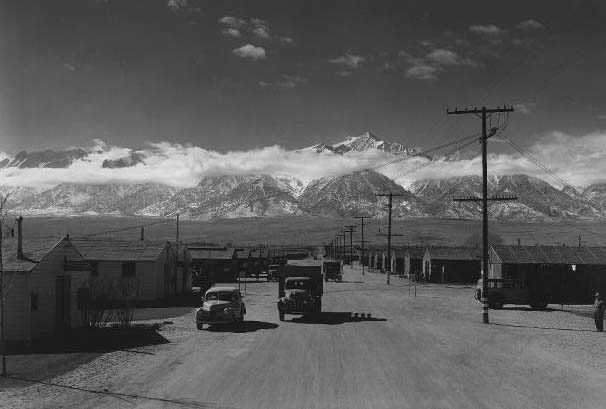
Ansel Adams photograph of Manzanar, 1943, Library of Congress

I was excited to learn that an American literature teacher and journalist in Shanghai, Britte Marsh, is having her tenth grade literature class study my essay on the World War II Japanese American prison camp Manzanar. Britte’s lesson plan is intriguing: to have her international school students read the young adult novel The War Between the Classes by Gloria D. Miklowitz and supplement that reading with my 18-part series.

The combination is a good one because the book is about a high school teacher who devises a game designed to explore the themes of racism, classism and sexism. He divides his students into four artificial classes, or socioeconomic strata, each designated by different-colored arm bands. This new order upends the natural hierarchy of the class: rich white students become the poorest of the poor and must bow and scrape to their superiors, the minority students. The protagonist, a Japanese American girl, also becomes aware of her family’s incarceration in a World War II U.S. government prison camp.

Britte wrote to me, “Together with the novel, I anticipate that your series will encourage my students to connect the dots between stereotyping, racial prejudice, media and ownership of familial heritage.” Out of her class of 13 tenth graders, only three had heard about the forced removal and imprisonment of West Coast Japanese, perhaps not surprising since none of them are Americans. One boy who was familiar with this chapter of American history was a Japanese student, again not surprising, since the topic is of great interest to the Japanese, who are probably on the whole more aware of the story than the average American.


The emails from Britte came at an interesting time, during the weeks leading up to the 70th anniversary of President Franklin Delano Roosevelt’s signing of Executive Order 9066, which authorized the imprisonment of West Coast Japanese Americans as a “military necessity.” Just as this essay on Executive Order 9066 that I wrote for The Daily was posted, the Asian American American Journalist Association’s (AAJA) listserve was exploding daily with fresh comments about Jeremy Lin, the American-born Knicks basketball sensation who seemingly came out of nowhere to galvanize both his injury-ridden team and the world. Every day a fresh example of racial stereotyping, if not racism, was unearthed, in headlines, on Twitter, and by sports commentators. AAJA was admirably on the ball in spotting and drawing attention to these, and even issued a media advisory (since the AAJA site is temporarily down, I'm linking to member Lia Chang's site, which has the advisory posted) with tips on what is acceptable coverage of Lin and what is not.

Although global attention has been mostly admiring, and angled as the classic underdog story of an unknown breaking out to become a star, I couldn’t help but notice some parallels between Linsanity coverage and the treatment of Japanese Americans during World War II. For one thing, it’s hard for some sports journalists and fans to see Lin as the American that he is. Just as the Nisei, or American-born Japanese Americans, were during World War II, he is considered foreign. Someone like Alex Rodriguez is not defined as a Dominican immigrant, even though he lived in the Dominican Republic for part of his childhood. A first-generation Irish or German American pro athlete would be even less susceptible to such perceptions.

The AAJA media sheet advised reporters and editors, “Jeremy Lin is Asian American, not Asian…Lin’s experiences were fundamentally different than people who immigrated to play in the NBA…to characterize him as a foreigner is both inaccurate and insulting.” Reading this for me evoked the cognitive dissonance of seeing prison camp photos filled with high school-aged Japanese Americans recreating the rituals, fashions and hairstyles of the all-American high school—the yearbooks, glee clubs, bobby socks and baseball teams—only behind barbed wire.

A lot has changed since those long ago days, and Jeremy Lin’s story is proof of that. Yet his story also reminds us that some things are still the same. 

February 13, 2012

The Sushi Wizard of Vancouver: Hidekazu Tojo

Every time my family and I visit Vancouver a stop at Tojo's restaurant is a must. I first met chef Hidekazu Tojo probably 20 years ago when I was on assignment in Vancouver for a People magazine story. I sat at the bar and he plied me with one of his signature dishes, jewel-like cubes of raw tuna bathed in a perfectly balanced soy vinagrette. Tojo-san's fish is always the freshest, and his sushi and western-style plates are among the most inventive I've ever come across, in the U.S., Canada or Japan. By the end of the evening I was fast friends with the trio of Japanese visitors sitting next to me, as can only happen at the bar of a sushi restaurant where the chef acts as convivial host, quietly slipping fresh delights across the bar, keeping the drinks flowing and the conversation purring.

Tojo-san provided the sushi for my wedding rehearsal dinner a few years later, and on different trips back it was good to see his restaurant thriving. One year there was a complete redecoration and we sat on the fabulous outdoor rooftop dining area, where we enjoyed a "baseball" of different kinds of small-diced raw tuna and the best una-kyu (eel and cucumber) hand rolls I've ever tasted. On this last trip, Tojo-san had moved down the street to a much larger, airier space with soaring ceilings and a ocean-blue color scheme. When his landlord at the former site hit him with a huge rent increase (some things are the same whether you're in Manhattan or Vancouver), a loyal patron came through and found him his new site, Tojo-san told us.

Here is Tojo-san's Great Pacific Roll, an inside out roll made with wild Pacific salmon, avocado and even more salmon on top:


And here's a western-style salmon preparation, part of the chef's tasting menu, with winter vegetables, several kinds of mushrooms, garnished with slivered yuzu and ribbons of daikon.

 
Like many things in Vancouver, I wish Tojo's were around the corner from my Manhattan apartment!

January 30, 2012

A Southern Indian Lunch at Saravanaas


 I love the brilliant spices and subtle flavors of Indian food, but only know the standard dishes found in most American Indian restaurants. So it was a culinary windfall for us to be introduced to Southern Indian cuisine yesterday at the vegetarian restaurant Saravanaa Bhavan by my friend Sambhavi and her family.


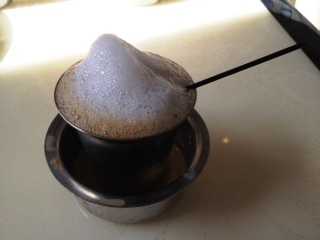
We started off with this Madras coffee. Though the non-native drink was introduced by western settlers, India is now a nation addicted to the brew, apparently even in a worse way than our venti-hugging nation. Frothed with milk, it comes in a stainless steel cup and deep saucer. Sambhavi showed me how to drink it from the rolled lip: without mouth ever coming into contact with cup. People from the region of her hometown Chennai are fanatic about hygiene, she explained, and this method really cuts down on dishwashing. Utensils are generally eschewed for fingers, and “really orthodox” traditional older women, she added, have perfected the  art of “flinging food into their mouths” without touching fingers to mouth so as not to spread their germs in communal plates. Before they have mastered this art, children have been known to create a holy mess from missed shots.  

After this lesson in eating technique (though I wasn’t brave enough to try the flinging method), we dived into some delicious appetizers. Most are made with a fermented rice and white lentil flour prepared in different ways. Steamed “mini ghee idlies” were lovely light dumplings napped with sambar, a sauce of dal (lentils) and other vegetables and spiced with curry leaf, fenugreek and tamarind. We loved their texture, and the contrasting crisp outer shell of another preparation,  sambar vada, a deep-fried donut like appetizer accompanied by creamy coconut chutney, coriander chutney and sambar. There were whole chili fritters made with chickpea batter (chili bhajji), and a Bombay street food called pav bhaji, a kind of spiced vegetable stew served with a toasted soft white bun.


For main courses, we tried a variety of dosas. I chose the onion rava masala since Sambhavi promised the addition of semolina would render it extra crispy. It looked like a giant lace napkin or a butterfly had landed on my plate, and was deliciously flavored with cumin and whole peppercorns. Underneath was a mess of creamy potatoes blended with mustard seed and onion, and then the various chutneys to dip them in. We also sampled puffed-up deep-fried puri that was as round and bumpy as a blow fish, and an even more dramatic-looking paper dosa, which resembled a gigantic, very crispy crepe rolled into a cylinder. I would be happy eating like this every day.


Last, Sambhavi ordered a round of comforting desserts: gulab jamon, fluffly, milk-curd-based orbs floating in a rose water syrup, and badam halwa, a ground almond pudding cooked in honey and butter and scented with saffron. 

Next it’s our turn to find a place that will put together an interesting and delicious vegetarian feast. Any suggestions?


December 27, 2011

New Year's Feasting, Japanese Style

It was a full year ago when I reported this November-December 2011 Edible Manhattan article on osechi-ryori, the traditional Japanese New Year's foods that evoke memories of family, home and tradition for those who grew up in Japan or in an osechi-observant household.


Here's the gorgeous three-tiered box that chef Hideki Yasuoka of the Nippon Club in Manhattan prepared for the lucky members who pre-ordered boxes last year. The smaller ayu, or sweetfish, in the box at the fore are simmered for four hours in a soy and saké mixture until they will practically dissolve in your mouth, and each component contains symbolic meaning, usually pertaining to longevity, good fortune, fertility--all the things peoples' wish upon each other for the New Year.


Since I grew up eating these foods, I love them and wish I could eat them every New Year. Yet many Japanese have no real interest in these traditional foods. One year, I searched for the best osechi boxes in New York City to serve to two young relatives who were visiting from Japan. They turned up their noses at the boxes, and were much more interested in steaks and burgers.


My reporting took me to Katagiri, the Manhattan Japanese grocery store, where I talked to shoppers stocking up for their New Year's celebrations.


These New Year's decorations of plastic rice cakes and good luck Daruma dolls would be the equivalent of putting a fake Christmas tree up in your home. 

Thanks to the site Discover Nikkei, which re-posted my article here  and discussed it on Facebook, I've received some interesting feedback on the story. Nina Kahori Fallenbaum, food editor at Hyphen , introduced me to this amazing-looking place in San Francisco, Peko-Peko, which is offering this luxury osechi bento
I'm in Vancouver, B.C., now, where a quick search for osechi didn't turn up anything. If any of you know where I can find a good osechi box hereabouts, let me know!

December 19, 2011

Latke-palooza Returns to Brooklyn


Tonight, the humble latke became the crispy blank canvas upon which a over a dozen New York City chefs let their imaginations play. It was Great Performances and Edible Brooklyn's third annual latke festival, so massive and crushingly well-attended it took up two floors of the cavernous opera house at BAM.

The winner was chef Jason Weiner's (Almond) super-crispy latke with house-smoked bluefish and yogurt sauce. The traditional Hanukkah food was at home with the smoked fish, and the yogurt accompaniment provided the perfect light touch to offset the oil and saltiness of the pancake and fish.


Weiner's entry didn't play it safe like Veselka's very traditional (satisfyingly so) sour cream and applesauce entry, nor did it go to the opposite extreme like this contender from Mae Mae Cafe: rye latke with cabbage flan, corned beef, Swiss cheese fondue and a dill pickle. Judge Michael Arad, the architect and designer of the 9/11 Memorial, dismissed it as "a Reuben not a latke."  Another taster, though commented appreciatively, "It's so Jewish; it even comes with a dill pickle."


I took a shine to this picturesque gem from Julian Medina of Toloache, shredded potatoes fried very crispy and salty with a spicy jalapeno sauce. And also to this demure entry, People's Choice Award winner Bill Telepan's (Telepan) celery root and potato latke.


And finally, for dessert, Ron Ben-Israel (Ron Ben-Israel Cakes) served up a delicious potato and parsnip latke brulee with cranberry sauce. Eat your hearts out, latke lovers!