Showing posts with label Heart Mountain. Show all posts

September 4, 2015

A Mother's Farewell to Heart Mountain


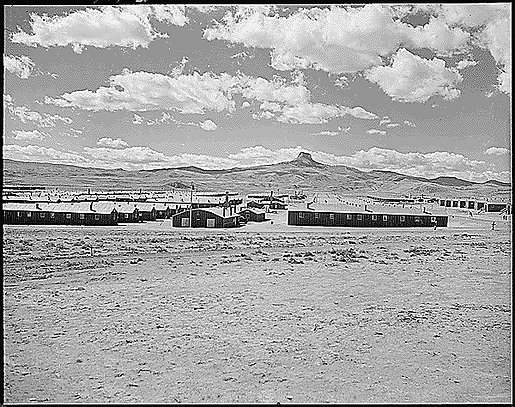
Heart Mountain Relocation Center, Heart Mountain, Wyoming. 
Looking west over the center with its sentry namesake, 
Heart Mountain, on the horizon.  (NARA 538782)

Late last month I attended a pilgrimage to Heart Mountain, Wyoming, the former U.S. Government concentration camp where my mother and her family were placed for three years during World War II. My mother had not been back to Heart Mountain for 70 years, since she left as a girl of 12. She wanted to go, she told us, to see the mountain the camp was named after one more time. Its iconic shape, more like the angled smokestack of a cruise ship than a heart, had found a permanent home in her memory. While living in the prison camp she had even once had a nightmare about the mountain coming to life with flailing arms, rising up as if to smother her.

My mother, circa 1944, with the iconic Heart Mountain and camp
barracks behind her. 

The camp was one of 10 wartime prisons the U.S. government set up in remote locations of the country, where 110,000 prisoners, two-thirds of them U.S. citizens, were forced to live. The victims of wartime hysteria and race hatred following Japan's bombing of Pearl Harbor, they were stripped of their right to due process, forced to sell most of their belongings and given low-wage jobs running their own prison, as doctors, nurses, mess hall cooks, garment workers, policemen and farmers.

My mother in front of the mountain that still lives within her,
here obscured by smoke from forest fires in
states to the west. 

My mother claimed not to remember much else about camp. Yet as we made the 13-mile drive from Cody, where we were staying, to the site of the camp and as the mountain suddenly appeared in the distance, she gasped audibly and whispered, "Oh my god, I can't believe it." Tears came to her eyes, shocking her with their arrival. She was unprepared for the onslaught of feelings, she told us later, of nostalgia and sadness.

The weekend-long pilgrimage featured interviews with former prisoners, speeches by former U.S. Transportation Secretary and U.S. Commerce Secretary Norman Mineta and former U.S. Senator from Wyoming Alan Simpson (the two became friends when Simpson's Cody Boy Scout troop visited Mineta's Heart Mountain prison camp troop for a jamboree) and moving performances by the spoken word artist G Yamazawa.

A restored guard tower and the smokestack
from the prison camp hospital still stand.
But what made the biggest impressions on me were the stories of the former inmates themselves (so reduced in numbers now that the only ones still living were, like my mother, for the most part teen-aged or younger when they were in Heart Mountain). As we walked the former prison site and toured the Heart Mountain Foundation's sensitively organized interpretive center, memories flooded back to her.

She remembered the windstorms that sent tumbleweeds scuttling across the camp, and how unlike now, no matter how far you looked in any direction, all you saw was sagebrush and that looming mountain. She remembered the harsh, sub-zero winters, and one snowball fight that landed her in the Heart Mountain hospital: it contained a rock that left her eye swollen and bloodied. Inmates, mostly from the Los Angeles area, were totally unprepared for the climate. My mother remembered that first winter how everyone ordered pea coats from the Montgomery Ward catalog. She remembered the servers in the mess hall walking down the aisle with gallon cans of sugar, doling out one teaspoon per person (paltry to a child to wanted more), and how she loved roller skating on the smooth cement floor of the laundry room. She remembered in summers, catching horned lizards in the desert, and a murder in the barrack across from her family's--fallout from a love triangle. "We had a little of everything," she commented.


One wing of the 150-bed hospital, where my mother was treated
for a facial wound, remains.
Looking at a photo of the Heart Mountain swimming hole, my mother remembered "almost drowning" when she couldn't get out from under some sort of barrier. Later that day, on the short bus ride to a memorial site that commemorates inmates who joined the U.S. Army to fight in Europe, I spoke to another former prisoner, a retired Seattle newspaper editor, who had the exact same recollection. "I almost drowned in the swimming hole, he told me. There was a platform that all the kids would jump on, and I couldn't get out from under it."

The swimming hole still conjures memories of near-drownings.
My mother remembered my Uncle Tosh leaving camp early to join the army, one of more than 750 prisoners who left Heart Mountain to serve in the U.S. armed forces during the war. She remembered that when he asked her what she would like from the outside, she requested an Andy Russell record and a ring with her birthstone, pink zirconia. Fifteen of those servicemen who left Heart Mountain to serve were killed in battle, leaving their families to mourn behind barbed wire. To the great relief of our family, my uncle was not among them.

My mother also remembered Kiyoshi Okamoto, the founder of the Heart Mountain Fair Play Committee, coming in the back entrance to her family's grocery store in downtown Los Angeles before the war to talk politics with her father. At Heart Mountain, when the military presented its "loyalty questionnaire," the Fair Play committee drafted its stance: members were U.S. citizens loyal to the United States and willing to serve in the U.S. Army, but only if their legal rights were first restored and they and their families were released from the prison camp. The Fair Play Committee set itself apart from the "no-no" boys, those who refused to answer yes to two key questions: would they serve in the U.S. armed forces if asked, and would they swear unqualified allegiance to America and forswear any allegiance to the Japanese Emperor. Both groups, especially the "no-nos," were reviled by many who joined the U.S. armed forces, in part to prove their loyalty to America.

This photo, taken by prisoner Bill Manbo, shows the farewell held for
"no-no" prisoners, who were transported to the Tule Lake Segregation
Center in Northern California, where the "no-nos" were isolated.
My mother, who is now 82, does not think she will return to Heart Mountain. But she accomplished what she wanted to, to see that heroic mountain one more time. When I sent her this post to read before launching it, she told me there was one important fact that I'd gotten all wrong: the dream about Heart Mountain coming alive was not a nightmare at all, but actually a comforting dream.

"I always had good feelings about that mountain," she told me. "It's the one thing I thought about when I thought about Heart Mountain at all." I realized that it was I who had projected onto that dream all my assumptions about what her repressed feelings about camp must have been. Surely behind her innocuous memories there lurked fear, anxiety and anger, or at least if they were not her own emotions, they were the internalization of those picked up from her parents and other adults near to her?

Could it be, I asked, that making Heart Mountain a protective symbol was her child's way of coping with loss and tragedy? "That could be," she admitted doubtfully, "it's hard to say."

Perhaps the deeper emotional truth of what happened to my mother 73 years ago will never be recoverable, and I suspect it is the same for many of the former incarcerees I spoke to. They remembered the daily events of school and play, the fun they had, but also the harshness of the climate and their living conditions. Today they recognize the gross injustice of the treatment they received so long ago, but its sting rarely pierces the stoic armor of Japanese gaman (endurance, patience and tolerance) and the practical shikata ga nai (it can't be helped) attitude that became the default response of so many who were imprisoned.

Or maybe, as the translator and Fordham University Japanese language professor Mariko Aratani said to me, it's impossible to understand the Japanese reaction to the concentration camps because it belongs to "a totally different paradigm" than the worldview of most westerners and more assimilated Japanese Americans.

For my mother, the trip "was sort of like closure," she told me. "Going back after all these years, and having all those hidden feelings emerge, I now feel like I don't need to go back again." 


August 9, 2011

A new musical set in Heart Mountain, an indy film featuring Manzanar


Last week, I attended a workshop production of a musical called Allegiance, which tells the tale of the unconstitutional imprisonment of 120,000 West Coast residents of Japanese descent during World War II. The show is being developed by the Old Globe in San Diego, with music and lyrics by composer/producer Jay Kuo and book by Kuo and Lorenzo Thione.

 Having looked at popular depictions of this sad chapter of American history in the decades since World War II, I was interested to see how the musical, directed by Stafford Arima, would tell this story through the medium of musical theater.

The play follows the Omura family as they are abruptly uprooted from their lives as shopkeepers and students in Salinas, Ca. and sent to Heart Mountain, Wyo. Father Tatsuo (Paul Nakauchi) is a defiant Issei (like all Japanese immigrants at the time, barred from becoming a U.S. citizen) who refuses to sign the infamous “loyalty oath” swearing allegiance to and willingness to fight for the U.S. and forswearing allegiance to the Emperor and Japan. As American-born citizens, his sons James (Jose Llana) and Sam (Telly Leung) express the sentiments of the majority of Nisei at the time—the wish to prove their loyalty to America at any cost. James volunteers to fight in the all-Nisei 442nd Regimental Combat team, and Sam throws himself into the camp newspaper, The Heart Mountain Sentinel to write pro-America articles.

The production stars George Takei as old Sam (the story is structured as one long flashback, with a young and an old Sam). Lea Salonga is young Sam’s Japanese teacher and the fiancĂ©e of James.  In Heart Mountain, father and sons are on opposite sides of the tense political divide that separated loyalist Nisei, led by the accommodationist Japanese American Citizen’s League, and the vocal and defiant “No-No Boys,” who refused to sign the loyalty oath and protested their unjust imprisonment.

Opinion about this play will likely be divided among the Japanese American community that watches it, too. First, there is the squeamish uncertainty: is this going to be a Springtime for Hitler-like attempt at concentration camp musical theater? Turning deeply resonant Issei sayings (shikata-ga-nai/”it can’t be helped,” gaman/“persevere, do your best”) into the lyrics for a Broadway-style song-and-dance musical at first struck me as bizarre, and slightly cringe inducing. The songs, though, turned out to be moving tributes to the stoicism and unquenchable spirit of the prisoners.

Then there is the matter of historical accuracy. One friend, well-versed in Heart Mountain history, objected to the way the “No-No Boys” are treated as a mere plot device to gin up some drama, and their views not fully explained and honored. On the opposite end of the spectrum, viewers at earlier workshops apparently complained that toadying JACL head Mike Masaoka, as played by Paolo Montalban, was too much of a buffoon.

Yet there is a long history of musicals using the raw material of history as fodder for popular entertainment; think Evita, Porgy and Bess (which started as an opera), Les Miserables, and 1776, for example. The first two, especially, were criticized for factual inaccuracies, yet their mass appeal brought small pieces of history—however fudged, cheesed up, glamorized and overwrought the final product—to a mass viewership that most documentary filmmakers and historians can only dream of.

The musical’s outlook on the legality and morality of the mass roundup is in line with today’s views of the evacuation and concentration camps as a gross breach of civil rights and a stain on America’s reputation: JACL leader Mike Masaoka is portrayed as a spineless puppet, the “lapdog of the WRA” (War Relocation Authority, the government body created to oversee the mass incarceration), who suggests that suicide squads of Japanese American soldiers be sent into battle to prove how loyal the Japanese are to America. The camp director installs young Sam as a government mouthpiece at the Sentinel, using him as “bait” to get to the dissident inmates. (In fact, as my friend points out, there was no hiding of the No-No boys; they expressed their views and suffered the consequences of being sent to the even harsher Tule Lake concentration camp.)

This approach is a far cry from Ansel Adams’s 1943 collection of writings and photographs of Manzanar, Born Free and Equal. In it, Adams took pains to both praise the industry and neatness of the prisoners but called the concentration camps “only a rocky wartime detour on the road of American citizenship…a symbol of the whole pattern of relocation—a vast expression of a government working to find suitable haven for its war-dislocated minorities.”

I overheard two people sitting behind me talking about the evacuation and incarceration as a “sad chapter” in American history and “one we don’t hear about.” I hope that Allegiance will get more people talking about it, and send them to the history books to find out the full story of what happened. 

***                                                      

                
The indy film Littlerock, directed by CalArts graduate Mike Ott, has been pulling in favorable reviews on the festival circuit. I went to see a local screening because it stars two young Japanese actors, Atsuko Okatsuka and Rintaro Sawamoto as a brother and sister (also named Atsuko and Rintaro in the film) stranded in a dusty dead-end California town. Even more interesting to me, it features a trip to Manzanar.

Ott slaps two very Japanese characters down in the middle of Littlerock, a podunk Antelope Valley town where the young people pass the time drinking, partying, fantasizing about getting out, and trying to scrape by. They are befriended by a hapless dreamer, Cory, who pulls them into his circle. While Rintaro soon tires of the scene, Atsuko, getting in touch with her inner slacker and relishing the sheer otherness of this aimless existence, opts to stay behind and explore a budding romance.

Manzanar as their destination, along with San Francisco, is alluded to, but we don’t really know why these otherwise typical Japanese siblings want to visit the site of the former World War II Japanese concentration camp. Although Rintaro’s Japanese is serviceable, Atsuko, from the beginning to the end of the film, doesn’t utter a word of English. Her face is a blank slate; one of the few clues to her inner life comes from her voiced-over letters to her father. We learn that he and her brother are estranged, and that she lies to her father and tells him she is in San Francisco when she’s actually learning to make burritos at Cory’s father’s Mexicatessen.
                
Themes of racism, cultural difference and language barriers gain new resonance and the tone of the film abruptly shifts when Rintaro and Atsuko arrive at Manzanar, now a National Parks Service site, and tour the interpretive center. There are clips of FDR’s speech after Pearl Harbor, images of racist signs, and the “soul-consoling tower” ireito, or obelisk that marks the prison camp cemetery. It’s an abrupt and jarring shift to documentary mode, and we at last find out that there is a personal connection between the siblings and the camp. Atsuko muses to her father in a letter what her life might have been like had the war and the concentration camps not happened, and had she been born in America. But the final scene, a frustrating farewell phone call between Atsuko and Corey, who still can’t understand a word each other says, hints that the racial and communication divides that caused such trauma continue today.