July 2, 2014

Hello, Columbus, Part Two


A year ago, I visited Columbus and was impressed with its emerging food and drink culture and the enticing selection of vendors at the centrally located North Market.

Last week I dropped in on the city for the second time. It was kind of like when you revisit relatives and find a confident young adult in place of the gawky teenager you remember from before. In this filled-out version of Columbus, there were great coffee houses, brewery-restaurants galore, Korean joints, fried chicken and ramen, too. 

Rick Harrison Wolfe, director of North Market and my guide to the good-tasting nooks and crannies of Columbus, noted, for example, that in the three years since he's been back in the city, the number of food trucks has leap-frogged from three to fifty. There are suddenly eighty breweries in the state of Ohio, plus well-attended beer and wine festivals (twenty-one Ohio wineries will be at the latter this year; who knew?)  that help boost interest in those growing industries. 
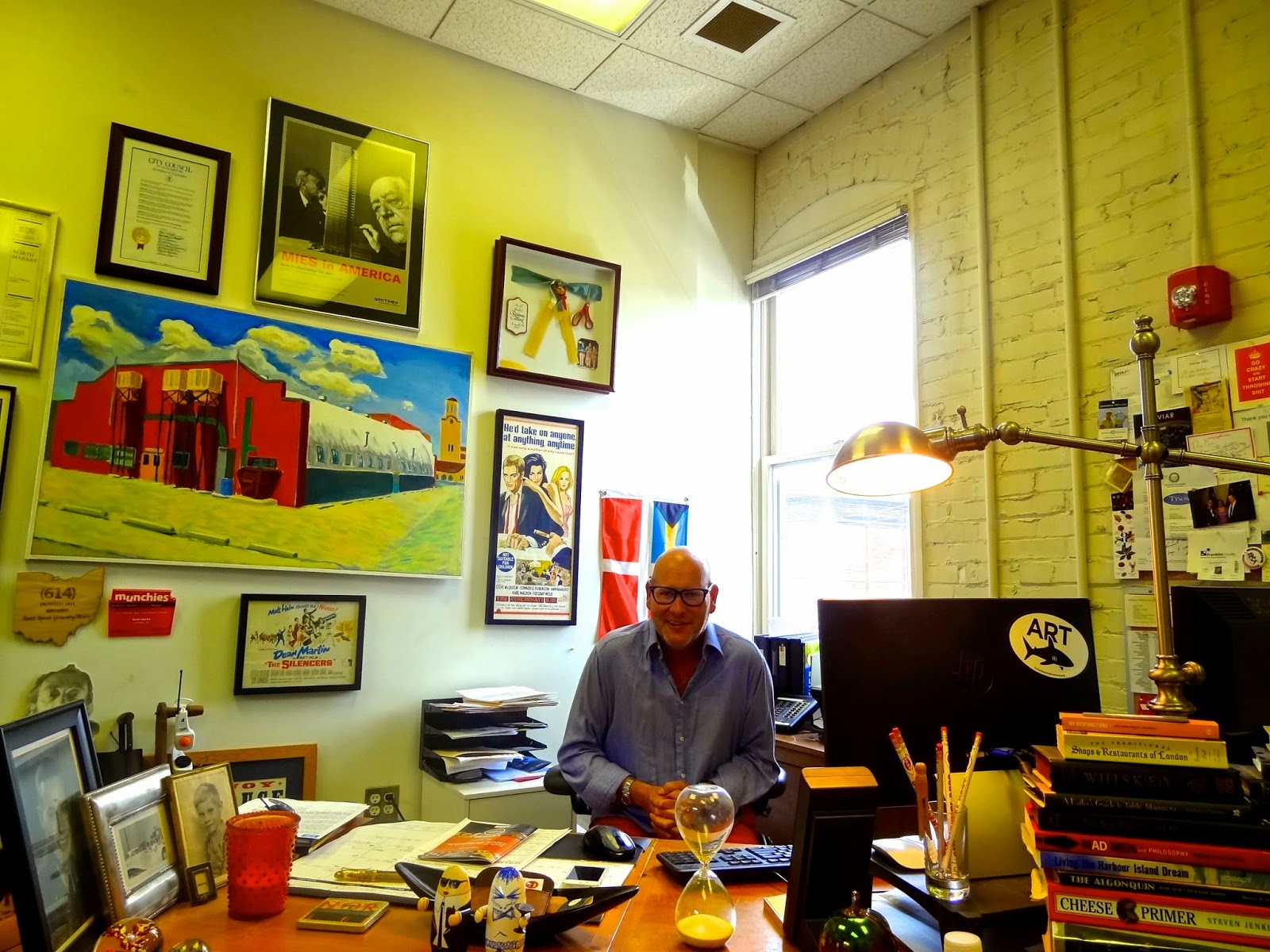
Rick Harrison Wolfe, keeping tabs on the Columbus scene
from his perch at North Market.

In addition to The Columbus Dispatch's food and drink quarterly Crave and of course Edible Columbus, I spotted another food and drink spin-off quarterly on this visit, Stock & Barrel, started by city magazine (614) Columbus. Intriguing fact gleaned from this publication: brewer Scott Francis of Columbus Brewing Company, the first microbrewery in the city, started a side business opening breweries for country clubs. This is not something you'll find in Brooklyn.
Outside view of North Market


And inside, where you can buy goat shanks and hearts.

Heading up to Wolfe's office, I passed a cart carrying goat shanks from the vendor Bluescreek Farm. Specializing in locally grown grass-fed beef, hog, lamb and goat, Bluescreek also offers whole-animal butchering and sausage-making classes. Jamie Smith, daughter of founders Cheryl and David Smith, told me that the restaurant Alana's Food and Wine near Ohio State University has driven demand with its delicious braised goat shank dish, and it seems that the classes have been a good way of converting students to believers in whole animal cooking. In this interesting Nola Studiola post, Jamie talks about the student who cooked stuffed boneless lamb breast as a result of taking several Bluescreek classes and doing its "butcher for a day" program. Let's see if this dish pops up on our neighborhood nose-to-tail restaurant menu!

View from the bar at Seventh Son Brewing Co. 

OYO refresher in a Mason jar.
I especially loved the concept at Seventh Son Brewing Co., a bright and airy indoor-outdoor brewery/bar in the city's Italian Village district. Since it doesn't have a kitchen, a different food truck parks outside every night, so you can order good, cheap grub to buffer the effects of a personality-filled beer and cocktail list. The night we were there, it was hot and savory Dutch Indonesian food from Aromaku. The above cocktail of OYO Honey Vanilla Bean vodka (from Columbus-based Middle West Spirits) was a winner, too.


June 25, 2014

Nose-to-Tail Dining at the Beard House with San Francisco's Bluestem Brasserie

On Friday, I attended an especially lively and fun Beard House dinner, full of fizz and crackle. If you've never been to one of these West 12th Street extravaganzas, imagine the book-lined library of a Victorian eccentric who was also partial to mirrored surfaces and pineapple-patterned wallpaper. Then imagine that room crammed with tables, each place setting packed with so many wine glasses and pieces of silverware that you feel like you're at a tableware trade show. That's what dinner at the townhouse once inhabited by American culinary icon James Beard feels like.

What made the night so special were our hosts, paragons of hospitality Adam and Stacy Jed, owners of Bluestem Brasserie in San Francisco, and the dinner that their gifted kitchen team, headed by chef Francis Hogan and pastry chef James Ormsby, sent out.


It was a perfect, mild summer evening for drinks and hors d'oeuvres in the garden, and the restaurant's signature Bluestem Smash cocktail, made with St. Germain, vodka, seasonal fruit, mint, lime and sparkling wine, provided the aforementioned fizz. The first crackle came courtesy of morsels of smoked salmon belly, paddlefish caviar, and crème fraîche on, yes, cracklings of salmon skin.


The other notable crunch of the night came on the outer edges of a cleverly conceived dish of slow-cooked Fallon Hills Ranch lamb belly. Like many dishes at Bluestem, this one was inspired by the self-imposed challenge of grass-fed, nose-to-tail whole-animal cooking. When four lambs and two pigs a week are delivered to your kitchen, as they are at Bluestem, what do you do with off cuts that other kitchens might discard? If you're Hogan, you stack lamb bellies six at a time,  rubbing them with olive oil, sea salt and rosemary, then slow cook the pressed blocks for twenty-four hours.  Lamb belly, he explained, is not fatty like that of pork, and only about three-quarters of a centimeter thick. Yet prepared his way and served with a blueberry agrodolce, preserved citrus yogurt and Douglas fir pine-scented Himalayan red rice, the layered, geological-looking lamb belly tasted just a succulent as its porcine counterpart.


I also liked the playful sweet-savory desserts that Hogan and Ormsby came up with. The first was a play on milk and cookies with a trio of goat and sheep's milk cheeses from Pennyroyal Farm in Mendocino sitting in for the milk. A chocolate shortbread Oreo-style cookie was filled with a whipped chevre-style Laychee and red wine-soaked cherries; a plush-rinded camembert-style cheese called Velvet Sister came balanced atop a crispy cornmeal biscotti made with a grassy olive oil, and a mission fig-filled shortbread accompanied a nutty aged goat and sheep's milk cheese called Boont Corners.


Hogan was so happy to be in a state where it's legal to purchase foie gras, that he requested that Ormsby build a second savory-sweet dessert around a torchon of Hudson Valley Foie Gras. He created a"PB and J" constructed of toasted, vanilla-soaked brioche, a peanut-cocoa nib tuile, caramelized white chocolate ganache and the disc of foie gras.

Asked what the difference was between cooking on the West Coast compared to our side of the country, Hogan who grew up in New Jersey and has cooked in restaurants in Philadelphia and Seattle as well, said, "The East Coast is more technique driven, and the West Coast is more ingredient driven--you can source so locally in San Francisco." Grrr. But we have the beauty of the changing seasons here, right? Appetite whetted for all that hyper-local sourcing, I'm counting the weeks before I can make another trip to the Bay Area.


June 18, 2014

At Shelburne Farms in Vermont, Steel Cut Oat Risotto

Can they look more content? Shelburne's Brown Swiss Cows.

This time of year makes me think of Shelburne Farms, the dynamic, progressive farm disguised as an idyllic retreat on the shores of Lake Champlain. It's a picture-perfect getaway as well as a working farm and a not-for-profit dedicated to educating for a sustainable future.

The 1,400 acre Vermont spread is what's left of a sprawling model farm and country retreat of the granddaughter of railroad magnate Cornelius Vanderbilt and her family. Now overseen by a board composed of educators, environmentalists, farmers and philanthropists, the not-for-profit helped launched the Farm-Based Education Network and is a leader in Vermont’s Farm to School program. It also offers onsite educational programs for young people and professional development sessions on sustainability, food and agriculture.

Peonies in the garden.

While there to attend the farm's annual weekend-long cheese making workshop, Pasture to Palate, I stayed in the Inn at Shelburne Farms, which has been restored to its 19th-century glory with many original furnishings, and is fronted by a formal garden that has likewise been shaped according to Lila Vanderbilt Webb's original design.


The steel cut oat risotto, dressed up with a garden flower. 

What stands out in memory, besides the many delicious Vermont cheeses I tasted, learning the cheddar-making process, and the beauty of the farm and its lovable animals (which children and adults are reminded will eventually feed us), is executive chef David Hugo's beautiful and satisfying steel cut oat risotto.  Hugo, a Vermont native who trained at the Culinary Institute of America and has cooked in kitchens from Paris to San Francisco, was named Chef of the Year in April by the Vermont Chamber of Commerce.

To make this dish, Hugo explains that he cooks two parts oats to one part whole milk risotto style, slowly adding the milk and stirring for about 20 to 25 minutes. He then adds a sauté of onions and bacon, a little more milk, and grated Shelburne Farms clothbound cheddar. The risotto is plated in a bed of sautéed farm-grown spinach, and finished with two poached eggs, also from the farm. You can't get more local, or delicious, than this mashup of Italian technique and farm-grown ingredients. 
 

May 12, 2014

Edible Institute 2014 Wrap-Up

Anna Lappé

Some quick thoughts about the wonderful and thought-provoking Edible Institute 2014 that I attended over the weekend. When Brian Halweil, who publishes four Edibles, in Manhattan, Brooklyn, East End and Long Island, opened the conference, he said one of his goals was to "draw a new path for the food and drink" community.

The conference, put on by Edible Communities Publications, did that, and more. New York Times columnist Mark Bittman, the day's keynote speaker, elaborated on his recent provocative Times op-ed piece asserting that good food advocates would do well to lay off the anti-GMO campaign and focus on issues of sustainability (including banning the prophylactic use of antibiotics on livestock and better pay for farmworkers) and banning marketing of junk food to kids under 19.

Nevin Cohen, a professor of environmental studies at The New School, teaches courses on food systems and is working on a book titled "Kale of Two Cities" (with apologies to Dickens and Mayor de Blasio, he said). He called out the "good food movement" for "being largely white," but pointed to activist groups like La Finca Del Sur, an urban farm cooperative in the South Bronx run by Latina and Black women.

A rollicking panel on seafood posed the question "How will small-scale fishers save East Coast seafood?" Moderated by writer Paul Greenberg, it was filled with great storytellers: Sean Barrett of Dock to Dish, Mike Martinsen of Montauk Shellfish Company and Newfoundland fisherman Bren Smith. Smith has invented something he calls "3-D ocean farming," which I love for it's economy and emphasis on raising the profile of seaweed in the pantheon of sea foods. Martinsen told a moving story (involving Buddhist chanting and the magical appearance of pilot whales as far as the eye can see) about how he lived through the collapse of the oyster and then lobster fisheries, then took a detour to get a degree in biology before partnering with one of his professors to start an oyster cultivation business. Because of these mighty bivalves' ability to filter estuaries and harbors and provide clean, sustainable sources of protein, Martinsen said somewhat incredulously, "I can't find anything wrong with what I'm doing."

Poet-famer Scott Chaskey of Quail Hill Farm in Amagansett, one of the country's first CSAs, talked about how he couldn't find a single earthworm on the farm's four acres when he started farming the land 30 years ago. Today, the farm has grown to over 30 acres and it's teeming with worms, thanks to sustainable practices that have allowed 500 varieties of vegetables and flowers to thrive.

Anna Lappé one of the founders of The Small Planet Institute and the daughter of Frances Moore Lappé opened day two with her keynote speech, an impassioned call for a kind of activism that can stand up to the might of deep-pocketed food and agriculture corporations and their lobbyists. Her practical advice included showing individual members of the community how small actions (a garden, a neighborhood coop) can add up, and quashing the oft-heard criticism that the fight for real food is led by "elitists." Chèvre eating aside, it's the multinationals that cynically push sugary junk foods on children who are the true elitists driving the majority of food sales in this country, she said, choking up with emotion at one point.

There were many more speakers to learn from but instead of relying on me, why not livestream it yourself? 

May 2, 2014

Support No Kid Hungry at our Brooklyn Flea Bake Sale!


Tomorrow is supposed to be a beautiful day, and it will be even more so if you head out to Brooklyn Flea and support the No Kid Hungry bake sale to help end childhood hunger. Since we "haves" like to help others by gorging ourselves, get out of bed and do your part by purchasing baked goods made by some of the most kick-ass bakers in the greater NYC area! Truly, I participated last year and realized there's an incredible amount of baking talent here that has coalesced into a tight-knit community. Here's your chance to sample some of their creations, have fun, and help a good cause. Oh, and check out our amazing raffle, which you can enter either in person or, for those of you who can't make it to Fort Greene, online. 

April 27, 2014

Navigating a Sea of Print at the Food Book Fair

Yesterday I made a trip to Williamsburg for the Food Book Fair. I only had time for one of the many enticing events on the menu, so I chose an event called Foodieodicals (no comment on name choice!), which took place in a basement room of the Wythe Hotel.

Who knew so many people, ranging from indie entrepreneurs from Scandinavia to hipsters from Rochester were creating food-related texts? There were gorgeous magazines on food and art, food and music, food and farming, food and women, you get the picture. It was enough to boggle the the mind, even one that has been covering small-batch, sustainable, locavore and artisanal food for a while now. Here is a pretty random list of some of my favorite people and publications:


Norwegian illustrator and coffee aficionado Lars K. Hulse (now based in London) created a cheeky guide called A-Z Coffee: A Kickstarter for Geeky Coffee Conversations, formed the design company Kaffikaze (stated goal: to spread "Extreme Coffee Enthusiasm) and brought with him an illustrated skateboard and many whimsical illustration. And he didn't even seem over-caffeinated; he was the picture of calm amid the crazy crush of writers, photographers, editors and publishers.


I flipped through an issue of Chickpea magazine, a quarterly published by Rochester residents Cara Livermore and Bob Lawton, which promotes a "whole-foods, plant-based way of life." In addition to being lovingly designed and featuring recipes for dishes like vegan raspberry chocolate chunk buckwheat bundt cake, I was floored to find an article by Mar Calpena on calçots in the Spring 2014 issue. Most people, Livermore told me, have never heard of these Spanish spring onions, which are treated with cult-like reverence in Catalonia when they emerge from the ground every year. The amazing thing is that I had just written about them in this Walking and Talking post. Weird, huh? The universe (that is, the one that Chickpea and I inhabit) is having a calçots moment. You can view the calçots article, and the entire issue, here.


On my way out, I spied a publication called The Runcible Spoon, described as "a zine about food and fantasy." The Runcible reps for some reason thought I would enjoy an edition called "The Cheap Issue," though it didn't seem like a particularly ripe area for fantasy. But they were right. I loved entries like this one by Becky Lettenberger about soup as a great source of cheap eating. Here's the recipe for cheap soup for college students: "Cook some ramen you stole from your roommate as directed, add a can of whatever beer you have available, fill a shot glass with the mixture and top with crushed potato chips. Chase with a swig of Barton's vodka. Repeat as necessary." That's resourceful college living!

April 3, 2014

At Barcelona's Llamber, Savoring Spring Green Onions


Ensconced in the back room of Llamber, a fine "gastronomic" tapas restaurant in the Born district of Barcelona, we made short work of these delicious grilled green spring onions. A meatier version of our scallions, they're known as calçots and are mild, sweet and so good.

The calçots from a certain region of Catalonia are so revered that they bear the label of EU Geographic Indication, bestowed on products that are unique to a region and pregnant with terroir. Their annual harvest sparks a celebration known as calçotadas, which involves throwing a bunch of calçots on an outdoor grill with big hunks of meat. The onions are grilled until they turn back, at which point lusty diners rip off the outer leaves, hold them by the stems, sweep them through the grainy romesco sauce that accompanies them, and devour them from the bottom up.

Scattered with sea salt and eaten with thick slices of grilled meat, you have the best family outing possible within a 30-minute drive from Barcelona. The hostel-type mountain houses that hold calçotadas grill all year, round, our server told us, but the biggest season is when the calçots are newly picked and you can eat at outdoor stone tables, drink a full-bodied Tempranillo or sparkling cava and feel glad to be alive. Worth planning a trip to Barcelona around, I'd say!